

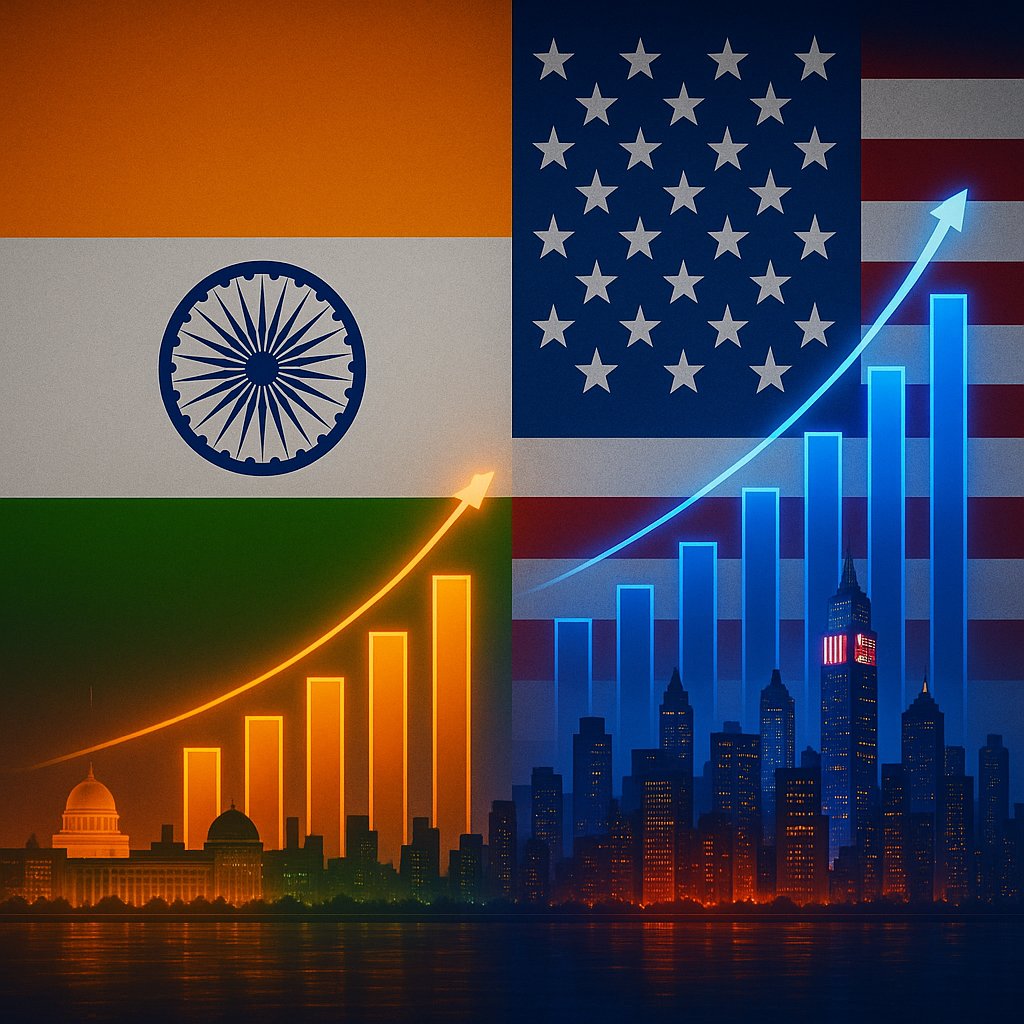
Introduction: A Tale of Two Economic Titans
The global economy is undergoing a massive realignment. The once-undisputed superpower, the United States, faces a new challenger — India, the world’s fastest-growing major economy.
While America continues to lead in innovation, capital markets, and military might, India is rapidly emerging as the growth engine of the global south, backed by demographics, digital transformation, and manufacturing power.
This isn’t just a comparison of GDP numbers — it’s a clash of economic models, philosophies, and futures.
Let’s dive deep into how the Indian economy stacks up against the American giant, across GDP, demographics, trade, innovation, and investment.
💰 1️⃣ GDP Size: The U.S. Is Still the King, But India’s Growth Is Royal
| Metric | United States | India |
|---|---|---|
| Nominal GDP (2025 est.) | $28 trillion | $4.5 trillion |
| Global GDP Rank | 1st | 5th |
| GDP Growth (2025 est.) | 2.1% | 6.8% |
| GDP (PPP) | $28T | $13T (3rd globally) |
The U.S. economy remains six times larger than India’s in nominal terms, driven by advanced industries, consumer spending, and innovation.
However, India’s GDP growth rate is three times higher, making it the fastest-growing major economy on the planet.
📊 Trend Insight:
If India sustains 6–7% growth and the U.S. averages 2%, India could become the world’s 3rd largest economy by 2028 — overtaking Japan and Germany.
🧠 2️⃣ Economic Structure: Services vs. Manufacturing Power
| Sector | United States | India |
|---|---|---|
| Services | 77% of GDP | 55% of GDP |
| Manufacturing | 18% | 17% |
| Agriculture | 1% | 15% |
The U.S. is a post-industrial economy, where services dominate — from finance and software to healthcare and defense.
India, meanwhile, is in the transition phase, shifting from agriculture toward manufacturing and digital services.
🔹 India’s strength: IT, fintech, pharmaceuticals, and space tech.
🔹 U.S. strength: Technology, defense, energy, and consumer industries.
The difference lies in maturity vs momentum — America is stable and mature, while India is still expanding its base.
👷 3️⃣ Demographics: Young India vs Aging America
| Metric | United States | India |
|---|---|---|
| Population | 340 million | 1.43 billion |
| Median Age | 38.5 years | 28.4 years |
| Working-age (15–64) | 64% | 68% |
| Dependency Ratio | 53% | 47% |
India has what economists call a demographic dividend — a massive, young, and employable population.
The U.S., on the other hand, faces labor shortages and an aging population, with immigration keeping its workforce afloat.
India’s youth power gives it a decades-long growth runway, provided it can generate enough jobs and skill opportunities.
“Demographics are destiny — and India’s destiny is being shaped right now.”
— Ruchir Sharma, Economist & Investor
🏭 4️⃣ Manufacturing & Industrial Growth: Make in India vs Made in USA
- The U.S. is reviving domestic manufacturing through the CHIPS and Science Act and Inflation Reduction Act, bringing semiconductor and green manufacturing home.
- India’s Make in India and PLI (Production-Linked Incentive) schemes aim to turn the country into a global manufacturing hub, attracting Apple, Foxconn, and Tesla.
📊 FDI Snapshot (2024–25):
| Country | FDI Inflows | Key Sectors |
|---|---|---|
| USA | $360B | Tech, energy, real estate |
| India | $70B | Manufacturing, IT, renewables |
Though smaller, India’s FDI is rising fast, with major multinationals diversifying away from China.
Verdict: The U.S. leads in capital intensity, but India wins on cost advantage and scalability.
📱 5️⃣ Digital & Innovation Economy: The Tech Race Narrows
| Metric | United States | India |
|---|---|---|
| Unicorns (2025) | 680+ | 110+ |
| Internet Users | 312M | 850M |
| E-commerce Market | $1.4T | $200B (growing 25% CAGR) |
| Fintech Transactions (UPI) | $3T (card-based) | $2.5T (UPI) |
The U.S. remains the innovation powerhouse, home to Silicon Valley and global tech giants like Apple, Microsoft, and Google.
But India has quietly become the world’s largest digital economy by transaction volume, thanks to UPI, Aadhaar, and JAM Trinity.
Startups in India are building global-scale solutions in AI, fintech, logistics, and edtech, often at a fraction of U.S. cost.
📈 India’s digital revolution = inclusion + innovation.
💵 6️⃣ Per Capita Income: America’s Wealth vs India’s Scale
| Metric | United States | India |
|---|---|---|
| Per Capita GDP (Nominal) | $82,000 | $3,200 |
| PPP Adjusted | $82,000 | $9,300 |
| Middle Class Share | 90% | 37% (rapidly expanding) |
The average American earns 25x more than the average Indian, reflecting the huge gap in living standards.
However, India’s cost of living is 6–8x cheaper, and its middle class (500+ million) is growing faster than any other nation’s.
By 2035, India’s consumption economy is expected to touch $6 trillion, making it a goldmine for global brands.
🌐 7️⃣ Trade, Exports & Global Integration
| Metric | United States | India |
|---|---|---|
| Total Trade (2024) | $7.1T | $1.4T |
| Exports | $2.7T | $480B |
| Imports | $4.4T | $920B |
| Top Partners | EU, China, Canada, Mexico | US, UAE, China, EU |
The U.S. dominates global trade and remains the world’s reserve currency hub.
India, however, is shifting its focus from services exports to manufactured goods, energy, and defense.
Key Indian export drivers:
- Electronics (iPhones, semiconductors)
- Pharmaceuticals (20% of global generic supply)
- Software & IT services (>$180B/year)
Verdict: America leads in trade volume; India leads in trade velocity.
🪙 8️⃣ Currency & Financial Strength
| Metric | U.S. Dollar | Indian Rupee |
|---|---|---|
| Global Reserve Role | 59% of global reserves | 2% of Asian trade settlements |
| Stability | High | Moderate (managed float) |
| Forex Reserves | $250B | $650B |
| Inflation (2025 est.) | 3.2% | 4.9% |
The U.S. dollar remains the world’s dominant currency, used in most global transactions.
India, however, is pushing for rupee internationalization, signing trade settlements in INR with countries like UAE and Russia.
As de-dollarization trends grow, India could benefit as an alternative Asian settlement hub.
📊 9️⃣ Stock Market Power: Wall Street vs Dalal Street
| Metric | United States | India |
|---|---|---|
| Market Cap (2025) | $52 trillion | $5.3 trillion |
| Major Index | S&P 500 | Nifty 50 / Sensex |
| No. of Listed Companies | 6,000+ | 5,800+ |
| Retail Participation | 38% | 14% (growing fast) |
The U.S. stock market is the world’s largest wealth creator, home to trillion-dollar firms like Apple, Microsoft, and Nvidia.
But India’s markets are the fastest-growing globally, with record IPO activity, mutual fund inflows, and demat accounts (15+ crore).
Verdict:
- U.S. = Maturity + Liquidity
- India = Momentum + Retail Power
🌱 10️⃣ Future Outlook: Slow & Rich vs Fast & Rising
🇺🇸 United States:
- Strengths: Innovation, global dominance, deep capital markets.
- Weaknesses: Aging demographics, high debt ($35T+), political polarization.
🇮🇳 India:
- Strengths: Demographics, digitalization, domestic consumption.
- Weaknesses: Income disparity, job creation lag, policy execution gaps.
By 2040, India is projected to become the second-largest economy (PPP terms) — a position long held by China.
“The 21st century belongs to nations that combine growth with stability — and India is showing it can do both.”
— Morgan Stanley Global Research (2025)
⚖️ Final Comparison: India vs America at a Glance
| Category | Winner | Comment |
|---|---|---|
| GDP Size | 🇺🇸 USA | Still unmatched |
| GDP Growth | 🇮🇳 India | Fastest in world |
| Innovation | 🇺🇸 USA | Silicon Valley edge |
| Digital Inclusion | 🇮🇳 India | UPI revolution |
| Demographics | 🇮🇳 India | Younger workforce |
| Per Capita Wealth | 🇺🇸 USA | 25x higher |
| Market Potential | 🇮🇳 India | Untapped scale |
| Global Influence | 🇺🇸 USA | Reserve currency & defense power |
| Future Growth Outlook | 🇮🇳 India | Decade of acceleration |
🧭 Conclusion: From Followers to Equals
India and the U.S. are two sides of the same coin — one a mature economic superpower, the other an emerging juggernaut.
The United States remains the beacon of innovation and capital, but India represents the future of growth, demand, and demographics.
While America defines the present of global economics, India is shaping its future.
In the years to come, the synergy between these two democracies — in trade, tech, and defense — could shape the world’s next economic era.



Leave a Reply