

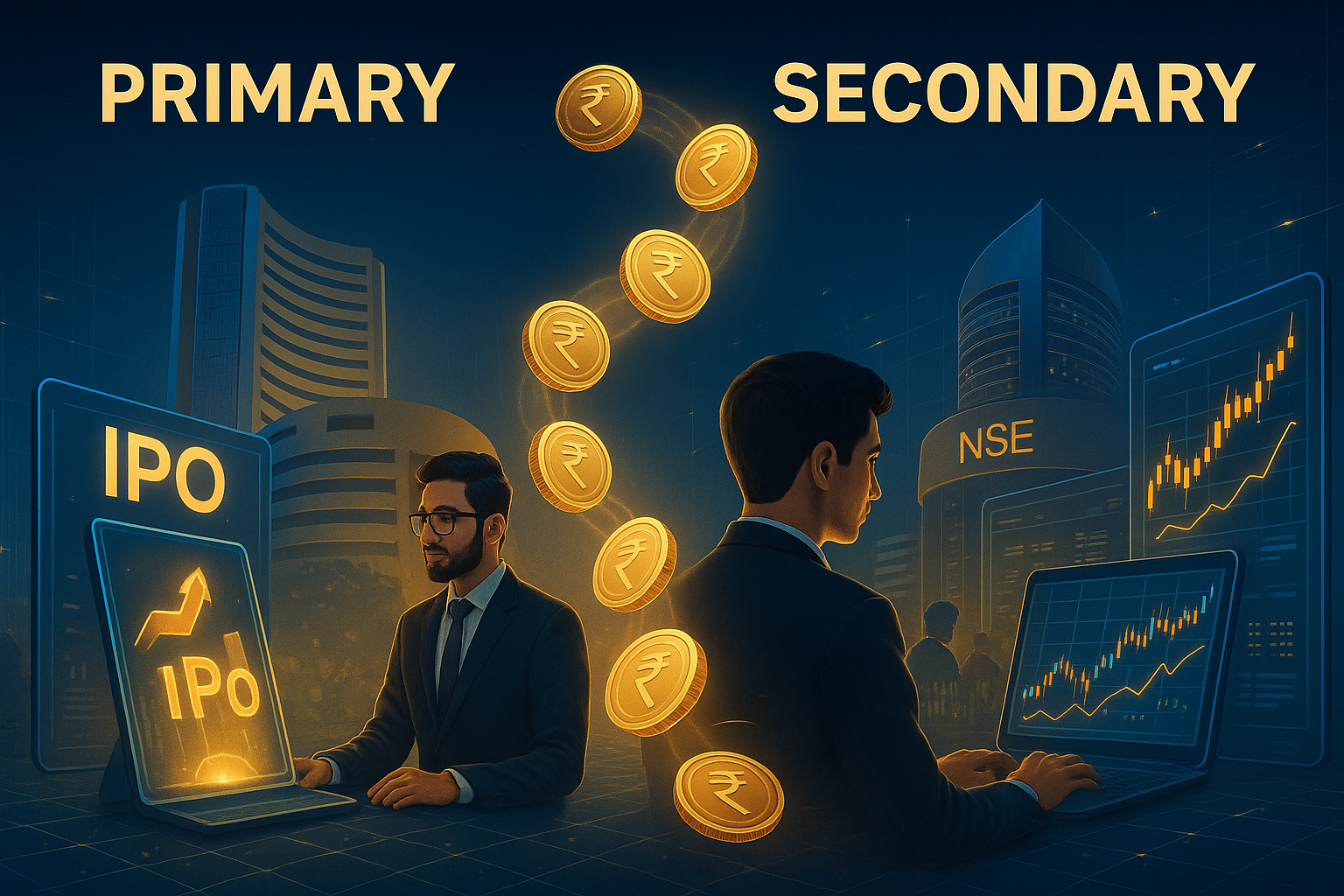
Introduction: The Backbone of India’s Stock Market
When you invest in the stock market, you’re stepping into one of the most dynamic financial ecosystems in the world — the Indian capital market.
But did you know there are two different markets where all buying and selling of securities take place?
These are the Primary Market and the Secondary Market.
Understanding the difference between them is crucial for every investor, whether you’re just starting out or already trading regularly.
Let’s break down what they mean, how they work, and how both play an essential role in the journey of every listed company in India.
1. What Is the Primary Market?
The Primary Market is where companies issue new shares or securities for the first time to raise capital.
It’s also known as the New Issue Market, because it deals with fresh securities that are not traded before.
💡 Example:
When a company like Zomato, LIC, or Tata Technologies decides to go public and offer its shares for the first time — that’s happening in the Primary Market, through an IPO (Initial Public Offering).
Investors apply for these new shares directly from the company via brokers or online platforms.
Purpose of the Primary Market
- To help companies raise long-term funds for expansion or new projects.
- To give investors a chance to own shares before they start trading publicly.
- To promote corporate growth and financial inclusion.
“The Primary Market is where ownership begins — the birth of every public company.”
Key Features of the Primary Market
✅ Securities are sold for the first time.
✅ Money goes directly to the issuing company.
✅ Companies issue shares, debentures, or bonds.
✅ Requires SEBI approval and detailed prospectus.
✅ Price may be fixed or determined through book building (auction-based pricing).
Types of Issues in the Primary Market
| Type of Issue | Description |
|---|---|
| Public Issue (IPO/FPO) | Company sells shares to the general public. |
| Rights Issue | Offered to existing shareholders to buy more shares. |
| Private Placement | Shares sold privately to select investors. |
| Preferential Issue | Offered to specific institutions or promoters. |
So, whenever a company creates new securities, it’s a Primary Market transaction.
2. What Is the Secondary Market?
Once the shares are issued in the Primary Market, they start trading on a stock exchange — this is the Secondary Market.
Here, investors buy and sell existing shares among themselves.
The company does not receive money from these trades — the transaction happens between investors.
“If the Primary Market is where companies raise money, the Secondary Market is where investors make money.”
Example:
You bought Reliance shares during its IPO — that was the Primary Market.
When you later sell those shares to another investor on NSE or BSE, that’s the Secondary Market in action.
Key Features of the Secondary Market
✅ Shares are already issued and listed.
✅ Trading happens on recognized stock exchanges (NSE, BSE).
✅ Transactions occur between investors (company not involved).
✅ Provides liquidity and price discovery.
✅ Regulated by SEBI for fair trading practices.
3. Primary vs Secondary Market: Key Differences
Here’s a quick comparison table to make it crystal clear 👇
| Basis | Primary Market | Secondary Market |
|---|---|---|
| Meaning | Where new securities are issued for the first time | Where existing securities are traded |
| Participants | Company and investors | Investors only |
| Purpose | To raise fresh capital for companies | To provide liquidity to investors |
| Market Type | New Issue Market | Stock Exchange Market |
| Price Determination | Decided by company (fixed/book-building) | Determined by demand and supply |
| Intermediaries | Merchant bankers, underwriters | Brokers, stock exchanges |
| Regulation | SEBI approval required before issue | SEBI monitors trading activities |
| Risk | Higher (new securities) | Lower (established prices) |
| Example | Zomato IPO | Buying Zomato shares on NSE |
4. How the Process Works (Step-by-Step)
Let’s connect both markets with an easy timeline 👇
🏢 Step 1: Company Issues Shares (Primary Market)
A private company decides to go public. It files a DRHP (Draft Red Herring Prospectus) with SEBI and launches an IPO.
💸 Step 2: Investors Subscribe
Investors apply for shares through online platforms like Groww, Zerodha, or Paytm Money.
📈 Step 3: Shares Get Allotted
Once the IPO closes, shares are allotted based on demand, and the company receives the funds.
🔁 Step 4: Shares Listed on Stock Exchange
After allotment, the company’s shares get listed on NSE and BSE for open trading.
🏦 Step 5: Secondary Market Trading Begins
Now, anyone can buy or sell those shares daily. Prices fluctuate based on market demand and news.
That’s how every stock transitions from the Primary to Secondary Market.
5. The Role of SEBI in Both Markets
The Securities and Exchange Board of India (SEBI) ensures both markets operate with integrity and fairness.
In the Primary Market, SEBI:
- Approves IPO documents
- Verifies company disclosures
- Protects retail investors from fraud
In the Secondary Market, SEBI:
- Monitors brokers and exchanges
- Prevents insider trading
- Ensures transparent price mechanisms
This regulation builds investor trust — a cornerstone of India’s stock market success.
6. Importance of Both Markets
Both markets are interconnected pillars of the financial system.
Let’s look at why each is essential 👇
💰 Importance of the Primary Market
- Raises capital for company expansion.
- Helps new companies grow and create jobs.
- Allows investors to participate early in strong businesses.
🔁 Importance of the Secondary Market
- Provides liquidity — investors can exit anytime.
- Reflects real-time market sentiment.
- Encourages participation through easy access and transparency.
“The Primary Market funds the economy; the Secondary Market fuels it.”
7. Example to Understand Better
Let’s take an example using Tata Motors 👇
- In 1990, Tata Motors issued new shares through a public issue — that was a Primary Market transaction.
- Today, millions of investors buy and sell Tata Motors shares every day on NSE and BSE — that’s the Secondary Market.
Both markets coexist and complement each other perfectly.
8. How You Can Participate in Both
To invest in the Primary Market:
- Watch out for upcoming IPOs on NSE/BSE or SEBI websites.
- Apply through brokers or UPI-based apps.
- Wait for allotment and listing.
To trade in the Secondary Market:
- Open a Demat and Trading Account.
- Choose reliable brokers like Zerodha, Groww, Upstox.
- Buy or sell shares directly through stock exchanges.
With just a smartphone, anyone can now invest and trade securely in both markets.
9. Common Misconceptions
❌ “Primary Market is only for big investors.”
→ Anyone can apply in an IPO — even retail investors.
❌ “Secondary Market is too risky.”
→ With knowledge and discipline, it’s manageable and rewarding.
❌ “Both markets are separate.”
→ They’re part of one continuous financial system.
Every company starts in the Primary Market and grows through the Secondary Market.
10. Primary vs Secondary Market in India (Current Trends)
📊 Primary Market Boom
India’s IPO market is witnessing record participation — from startups to large corporations.
In 2024 alone, over ₹80,000 crore was raised through new issues.
💹 Secondary Market Growth
Retail investor participation is at an all-time high, with over 16 crore Demat accounts active.
Digital platforms and SIPs have made investing easier than ever.
This surge shows the growing trust and maturity of Indian investors.
11. Risks and Rewards
| Market | Risks | Rewards |
|---|---|---|
| Primary Market | Limited price data, oversubscription, uncertain listing gains | Early entry in strong companies, potential high profits |
| Secondary Market | Price volatility, emotional trading | Liquidity, compounding, flexible investment options |
Balanced investors use both — IPOs for growth opportunities and stock trading for steady wealth building.
12. Real-Life Analogy
Think of the Primary Market as the “birthplace” of stocks — where they’re created.
And the Secondary Market as the “marketplace” — where they’re bought and sold daily.
You can’t have one without the other.
Just like a movie premieres in theaters (Primary Market), and later plays on OTT platforms (Secondary Market).
Conclusion: Two Markets, One Goal — Wealth Creation
Both the Primary and Secondary Markets are vital to India’s financial ecosystem.
The primary market raises fresh capital for companies; the secondary market keeps that capital moving by giving investors liquidity.
As an investor, understanding the difference helps you make smarter, well-timed decisions — whether you’re applying for IPOs or trading shares daily.
“The Primary Market is where opportunities are born.
The Secondary Market is where they are realized.”
So start learning, stay consistent, and participate confidently in both — with MyStockBzaar.com as your trusted guide to India’s financial future. 💼📈








Leave a Reply