


Introduction: The Beating Heart of India’s Financial Growth
The Indian stock market isn’t just a place where people buy and sell shares — it’s the engine that drives India’s economic growth.
From billion-dollar companies to everyday investors, everyone plays a role in this vibrant marketplace.
But for many beginners, the stock market can seem like a maze of numbers, jargon, and unpredictable trends.
If you’ve ever wondered — How does the Indian stock market really work? — this is your complete guide.
By the end of this article, you’ll understand exactly how money flows, trades happen, and how you can become a confident investor in India’s booming economy.
1. What Is the Stock Market?
The stock market is a platform where buyers and sellers come together to trade shares of companies.
When you buy a share, you own a small part of that company.
If the company grows and profits, your shares increase in value — that’s how investors make money.
India’s stock market primarily operates through two major exchanges:
- BSE (Bombay Stock Exchange) – Asia’s oldest stock exchange, established in 1875.
- NSE (National Stock Exchange) – India’s largest exchange by trading volume.
Both are regulated by SEBI (Securities and Exchange Board of India), which ensures transparency, fairness, and investor protection.
2. Why Does the Stock Market Exist?
The stock market serves two main purposes:
🏢 For Companies
It helps businesses raise funds by selling ownership (shares) to the public.
This money fuels growth — new factories, jobs, and innovation.
💰 For Investors
It provides a way for people to invest their savings and grow wealth over time.
In short:
“The stock market connects people who have money with companies that need it — and both benefit.”
3. How the Indian Stock Market Works (Step-by-Step Process)
Let’s simplify the working of the stock market into 6 clear steps 👇
Step 1: Companies Go Public Through IPOs
When a company needs capital, it offers its shares to the public for the first time via an Initial Public Offering (IPO).
Example:
When Zomato went public, it sold shares to investors through the NSE and BSE.
Investors apply for shares during the IPO, and once listed, the company’s stock starts trading live in the secondary market.
Step 2: Listing and Trading of Shares
After the IPO, the company’s shares become available for buying and selling on stock exchanges.
This is called secondary market trading.
Every trade on the NSE or BSE happens through registered stockbrokers (like Zerodha, Groww, Upstox, or HDFC Securities).
You can buy or sell shares anytime during market hours —
🕘 9:15 AM to 3:30 PM (Monday–Friday).
Step 3: The Role of SEBI (Regulator)
The Securities and Exchange Board of India (SEBI) regulates the entire market.
It ensures:
- No insider trading or manipulation
- Companies follow transparency rules
- Investors are protected from fraud
- Brokers and institutions operate fairly
Think of SEBI as the referee ensuring fair play in this massive financial game.
Step 4: Market Participants and Their Roles
The market operates smoothly because of several key participants:
| Participant | Role |
|---|---|
| Investors/Traders | Buy and sell shares |
| Brokers | Platforms that connect you to the exchange |
| Depositories (NSDL/CDSL) | Store your shares digitally |
| Clearing Corporations | Ensure transaction settlement |
| SEBI | Regulates and monitors the market |
| Stock Exchanges (NSE/BSE) | Facilitate trading activity |
When you buy or sell shares, these entities work together behind the scenes — instantly processing millions of trades every second.
Step 5: Price Determination (How Share Prices Move)
Stock prices change constantly — but why?
It all depends on demand and supply.
If more people want to buy a stock → price rises.
If more want to sell → price falls.
Price movements are influenced by:
- Company earnings
- Economic data (GDP, inflation, RBI policies)
- Global news
- Market sentiment
“The stock market is 20% logic and 80% emotion — understanding both is key to success.”
Step 6: Settlement Process
After you buy or sell shares, the settlement process ensures money and shares are exchanged correctly.
India follows a T+1 settlement cycle, meaning:
- If you buy shares on Monday → they’re credited to your Demat account by Tuesday.
This fast and transparent system makes the Indian market one of the most efficient globally.
4. How to Start Investing in the Indian Stock Market
Starting your journey is easier than ever.
Follow these steps:
Step 1: Open a Demat & Trading Account
You need two accounts:
- Demat Account → Stores your shares digitally.
- Trading Account → Executes buy/sell orders.
Open them online via trusted brokers like:
- Zerodha
- Groww
- Upstox
- Angel One
- ICICI Direct
Step 2: Complete KYC Verification
You’ll need PAN, Aadhaar, and a linked bank account.
Most brokers complete e-KYC within minutes.
Step 3: Learn the Basics
Understand:
- What are shares, IPOs, and mutual funds
- How stock prices fluctuate
- The difference between investing and trading
Step 4: Start Small
Invest small amounts — ₹500 or ₹1,000 — through SIPs or index funds.
Avoid risky penny stocks or “hot tips.”
Step 5: Stay Consistent
Invest regularly and hold quality stocks for years, not days.
Wealth grows with patience, not speed.
5. Understanding Stock Market Segments
The Indian stock market has three key segments:
| Segment | Description | Example |
|---|---|---|
| Equity Market | Buying/selling company shares | Infosys, HDFC Bank |
| Derivatives Market (F&O) | Trading contracts (Futures & Options) | Nifty Futures |
| Debt Market | Bonds & government securities | RBI Bonds, Corporate Bonds |
Beginners should focus on the Equity Market first — it’s simpler and ideal for learning.
6. Types of Investors in the Market
Different investors have different goals and strategies:
| Type | Approach | Duration |
|---|---|---|
| Long-Term Investors | Buy and hold quality stocks | 5+ years |
| Swing Traders | Capture short-term trends | Days to weeks |
| Intraday Traders | Buy/sell within the same day | Hours |
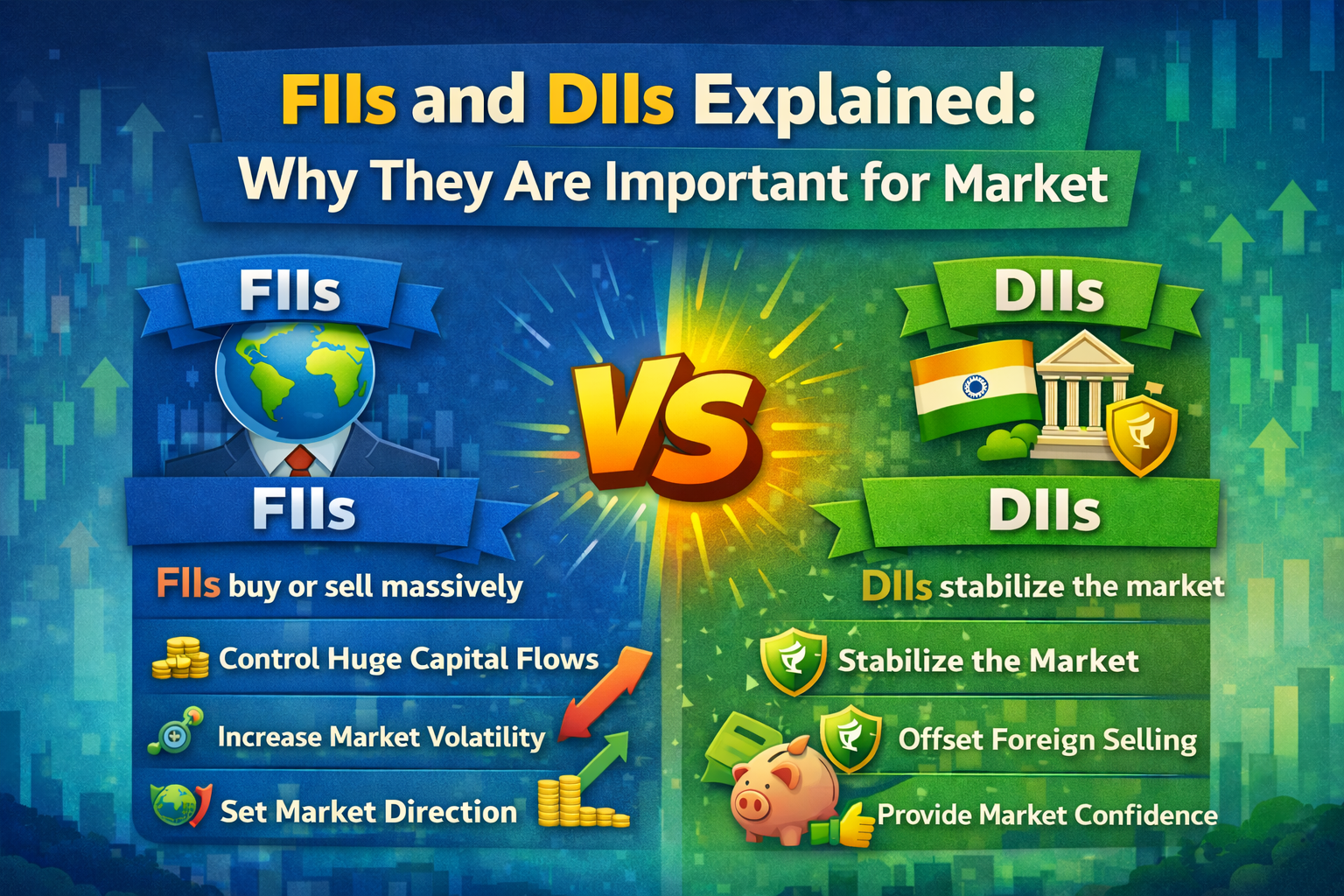
| Institutional Investors | Large organizations (FII/DII) | Large-scale |
| Retail Investors | Individuals like you and me | Flexible |
“Every big investor started as a retail investor — with patience and knowledge.”
7. How Companies Are Categorized (Market Cap)
Indian companies are grouped by their market capitalization (size):
| Category | Market Cap | Examples |
|---|---|---|
| Large Cap | ₹50,000 crore+ | Reliance, TCS, HDFC Bank |
| Mid Cap | ₹10,000–₹50,000 crore | Mphasis, Voltas |
| Small Cap | < ₹10,000 crore | Dixon, CDSL |
Large-cap stocks are more stable; small-caps are riskier but offer higher potential returns.
8. The Role of Indices (Nifty & Sensex)
Indices like Nifty 50 and Sensex represent the overall health of the stock market.
- Sensex → Top 30 companies on BSE
- Nifty 50 → Top 50 companies on NSE
If Nifty and Sensex rise, it means the market is doing well overall.
These indices are benchmarks for mutual funds, ETFs, and investor sentiment.
9. How Investors Make Money
You can earn money in the stock market in two main ways:
💰 1. Capital Appreciation
When you buy a stock at ₹500 and sell it at ₹800 — your profit is ₹300.
💸 2. Dividends
Some companies distribute a portion of their profits to shareholders.
Example:
Infosys regularly pays dividends, rewarding long-term investors.
10. Common Myths About the Stock Market
Let’s bust a few popular misconceptions 👇
❌ “Stock market is gambling.”
→ It’s not luck — it’s about knowledge, analysis, and patience.
❌ “You need a lot of money to start.”
→ You can start with as little as ₹500.
❌ “It’s only for experts.”
→ Every expert was once a beginner who learned the basics.
❌ “Markets are too risky.”
→ Risk comes from not knowing what you’re doing.
11. How SEBI Protects Investors
SEBI ensures:
- Brokers and companies follow fair practices
- No manipulation or insider trading
- Investors receive accurate information
If you face any issue, you can raise a complaint directly through SCORES (SEBI Complaint Redress System).
12. Tips to Succeed in the Stock Market
✅ Start early — compounding works best with time.
✅ Invest regularly — consistency beats timing.
✅ Stay informed — follow financial news.
✅ Diversify — don’t put all eggs in one basket.
✅ Avoid herd mentality — make independent decisions.
✅ Keep emotions in check — don’t panic or get greedy.
“Successful investing is about discipline, not drama.”
13. The Future of the Indian Stock Market
India’s economy is among the fastest-growing globally.
Rising incomes, digital infrastructure, and increasing financial awareness mean millions of new investors join the market every year.
With government reforms and strong corporate growth, the future looks bright.
Those who start early and stay consistent will benefit most from India’s decade of growth.
Conclusion: Your First Step into the Market
The Indian stock market might seem complex, but once you understand its structure, it’s a world of opportunity.
It’s where:
- Dreams become investments
- Investments become wealth
- And knowledge becomes power
Start small, learn continuously, and stay invested.
Because the earlier you start, the longer your money has to grow.
So, open your Demat account, explore your first stock, and step confidently into India’s financial future with MyStockBzaar.com as your guide. 🌐
“Don’t wait to buy stocks. Buy stocks and wait.” — Warren Buffett








Leave a Reply