

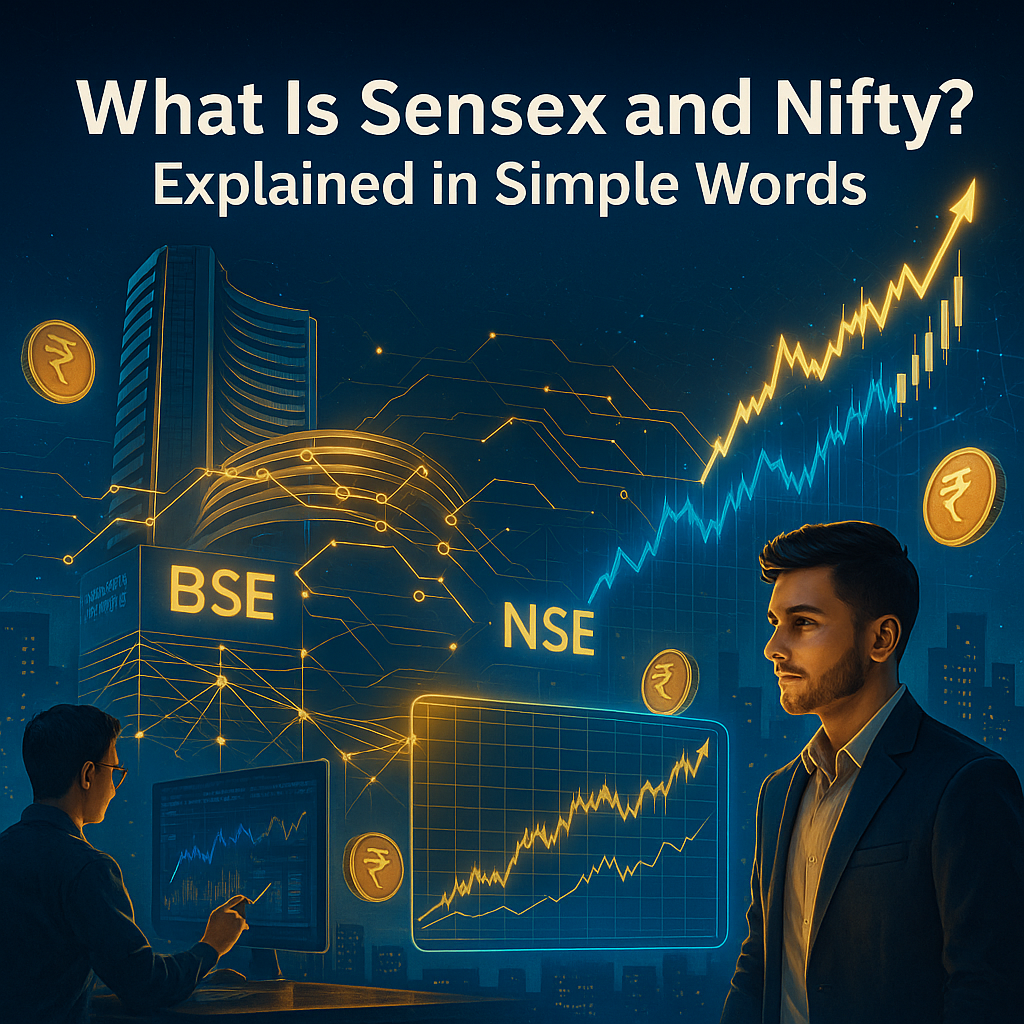
Introduction: The Pulse of the Indian Market
Every day, when you watch business news, you hear:
📺 “Sensex is up 300 points today,” or “Nifty slips below 22,000.”
But what do these numbers actually mean?
The Sensex and Nifty are not just random figures — they represent the heartbeat of India’s stock market.
Understanding these two indices is the first step toward becoming an informed investor.
They tell you how the market is performing, where the economy is heading, and what investors feel about India’s financial future.
Let’s simplify everything you need to know about Sensex and Nifty — step by step, in easy language.
1. What Is an Index in the Stock Market?
Before diving into Sensex and Nifty, let’s understand what a stock market index is.
A stock market index is like a scoreboard for the stock market.
It tracks the performance of a group of selected companies that represent the overall market or a specific sector.
If the index goes up, it means most major stocks are doing well — the economy is growing.
If it falls, it means stocks are under pressure — the economy might be slowing down.
In simple terms:
A stock market index = barometer of the market’s health.
2. What Is Sensex? (The BSE Index)
The Sensex, short for “Sensitive Index”, is India’s oldest and most trusted stock market index.
It was launched in 1986 by the Bombay Stock Exchange (BSE) — which is one of Asia’s oldest exchanges, established in 1875.
The Sensex tracks the performance of the top 30 companies listed on the BSE, chosen based on:
- Market capitalization (value of a company)
- Liquidity (how frequently it’s traded)
- Industry representation
- Financial stability
These 30 companies represent various sectors like banking, IT, energy, FMCG, and manufacturing — making the Sensex a true reflection of India’s economic performance.
Key Facts About Sensex
| Feature | Details |
|---|---|
| Full Form | Sensitive Index |
| Exchange | Bombay Stock Exchange (BSE) |
| Launched | 1986 |
| No. of Companies | 30 |
| Base Year | 1978–79 |
| Base Value | 100 points |
| Current Level (2025) | Around 73,000+ points (and growing) |
So, when you hear “Sensex rises by 500 points,” it means the combined value of these top 30 BSE-listed companies has increased.
Example:
If stocks like Reliance, HDFC Bank, Infosys, and Tata Motors perform well, the Sensex will go up.
If they fall, the Sensex drops.
Thus, the Sensex serves as an economic thermometer — it measures investor confidence and India’s corporate growth.
3. What Is Nifty? (The NSE Index)
The Nifty 50 is the flagship index of the National Stock Exchange (NSE), launched in 1996.
The term “Nifty” combines National + Fifty — representing the top 50 companies listed on NSE.
Like the Sensex, it includes companies from major industries and acts as a barometer of the Indian economy.
It’s also the most widely used benchmark for mutual funds, ETFs, and trading strategies.
Key Facts About Nifty
| Feature | Details |
|---|---|
| Full Form | National Fifty |
| Exchange | National Stock Exchange (NSE) |
| Launched | 1996 |
| No. of Companies | 50 |
| Base Year | 1995 |
| Base Value | 1,000 points |
| Current Level (2025) | Around 22,000+ points |
The Nifty includes companies like TCS, Infosys, HDFC Bank, ICICI Bank, Reliance Industries, ITC, and more — representing over 60% of India’s total market capitalization.
Quick Comparison Table: Sensex vs. Nifty
| Parameter | Sensex | Nifty 50 |
|---|---|---|
| Exchange | Bombay Stock Exchange (BSE) | National Stock Exchange (NSE) |
| No. of Companies | 30 | 50 |
| Launched | 1986 | 1996 |
| Base Year | 1978–79 | 1995 |
| Base Value | 100 | 1,000 |
| Type | Benchmark for BSE | Benchmark for NSE |
| Example Companies | Reliance, HDFC Bank, Infosys | TCS, ICICI Bank, ITC |
| Popularity | Traditional benchmark | Most traded & tracked index |
Both indices usually move in the same direction — if Nifty rises, Sensex also rises, because many of their companies overlap.
4. How Do Sensex and Nifty Work?
Let’s understand how these indices are calculated and how they reflect market changes.
Both use a method called Free-Float Market Capitalization.
💡 Free-Float Market Capitalization Explained
Every company has a total number of shares.
But not all shares are available for trading — some are held by promoters or governments.
The shares available to the public are called free-float shares.
So, the formula is:
Index Value = (Current Market Value / Base Market Value) × Base Index Value
This ensures the index changes only when freely tradable shares move in price.
In short:
- If big companies perform well → index rises.
- If they perform poorly → index falls.
Example:
If Reliance or HDFC Bank (which have large weights in the index) go up 3%, it can lift the Sensex/Nifty by hundreds of points.
5. Why Are Sensex and Nifty Important?
These two indices are the foundation of India’s stock market. Here’s why they matter so much 👇
📈 1. Measure of Economic Health
They reflect how top companies — and therefore the overall economy — are performing.
💰 2. Benchmark for Mutual Funds
Most mutual funds compare their performance with Sensex or Nifty to show returns.
📰 3. Market Sentiment Indicator
Rising indices indicate optimism; falling indices signal fear or uncertainty.
📊 4. Guide for Investors
Investors track Sensex/Nifty to decide when to buy or sell stocks.
🌍 5. Global Recognition
Foreign investors (FIIs) use these indices to assess India’s financial health.
“Sensex and Nifty are to India what the Dow Jones and S&P 500 are to the U.S.”
6. Major Sectors Represented
Both Sensex and Nifty include companies from all major industries — ensuring diversification.
| Sector | Examples |
|---|---|
| Banking & Finance | HDFC Bank, ICICI Bank, SBI |
| IT & Technology | Infosys, TCS, Wipro |
| Energy | Reliance, ONGC, NTPC |
| FMCG | ITC, Hindustan Unilever, Nestlé |
| Auto | Tata Motors, Maruti Suzuki |
| Pharma | Sun Pharma, Dr. Reddy’s |
| Infrastructure | Larsen & Toubro, Adani Ports |
This makes both indices an excellent representation of India’s economy as a whole.
7. How Can You Invest in Sensex and Nifty?
You can’t buy the index directly — but you can invest in funds that track them.
Option 1: Index Mutual Funds
These funds replicate Sensex or Nifty performance by investing in the same companies and proportions.
Examples:
- HDFC Index Fund – Nifty 50 Plan
- ICICI Prudential Nifty Index Fund
- SBI Nifty Index Fund
Option 2: ETFs (Exchange-Traded Funds)
ETFs trade on exchanges like stocks but mirror Sensex/Nifty.
Examples:
- Nippon India ETF Nifty BeES
- UTI Nifty Index Fund
- HDFC Sensex ETF
These options are ideal for beginners who want diversified exposure without picking individual stocks.
8. Key Differences Between Sensex and Nifty
While they serve the same purpose, there are small differences worth noting 👇
| Factor | Sensex | Nifty |
|---|---|---|
| No. of Stocks | 30 | 50 |
| Exchange | BSE | NSE |
| Companies Covered | Larger, established firms | Broader range across sectors |
| Trading Volume | Slightly lower | Higher (more traders use NSE) |
| Volatility | Slightly lower | Slightly higher |
In short — Sensex = Classic benchmark, Nifty = Modern market leader.
9. The History of Growth: From 100 to 70,000+
When the Sensex was launched in 1986, it was valued at 100 points.
Today, it’s crossed 73,000 points (as of 2025) — a 700x growth!
Similarly, the Nifty 50, which started at 1,000, now trades above 22,000.
This remarkable journey reflects India’s economic transformation — from a developing nation to a global powerhouse.
10. Factors That Move Sensex and Nifty
| Factor | Effect |
|---|---|
| Corporate Earnings | Strong profits → Index up |
| Inflation & Interest Rates | High rates → Market down |
| Government Policies | Reforms & budgets impact performance |
| Global Events | Oil prices, US Fed rates, geopolitics |
| Investor Sentiment | Fear & greed drive short-term moves |
Understanding these helps investors navigate volatility confidently.
11. Fun Fact: Sensex Milestones Over Time
| Year | Milestone |
|---|---|
| 1990 | 1,000 points |
| 2006 | 10,000 points |
| 2014 | 25,000 points |
| 2021 | 50,000 points |
| 2024 | 73,000+ points |
Every milestone represents India’s journey toward becoming a $5 trillion economy.
12. Should You Track Sensex or Nifty?
For most investors, both are equally reliable.
If you use the BSE platform, follow Sensex.
If you use NSE, follow Nifty.
But both move together — and tell the same story of India’s growth.
Conclusion: The Story Behind the Numbers
The Sensex and Nifty are not just market indicators — they’re India’s progress meters.
They reflect how Indian businesses are growing, how investors feel, and where the economy is heading.
If you’re new to investing, tracking these indices is your best way to understand market behavior before you buy your first stock.
So next time someone says,
“The Sensex is up 500 points,”
you’ll know — that’s not just a number, it’s the pulse of India’s economy beating stronger.
Start following the trends, understand how indices move, and invest wisely.
Because learning the market’s language is the first step to mastering it.








Leave a Reply