

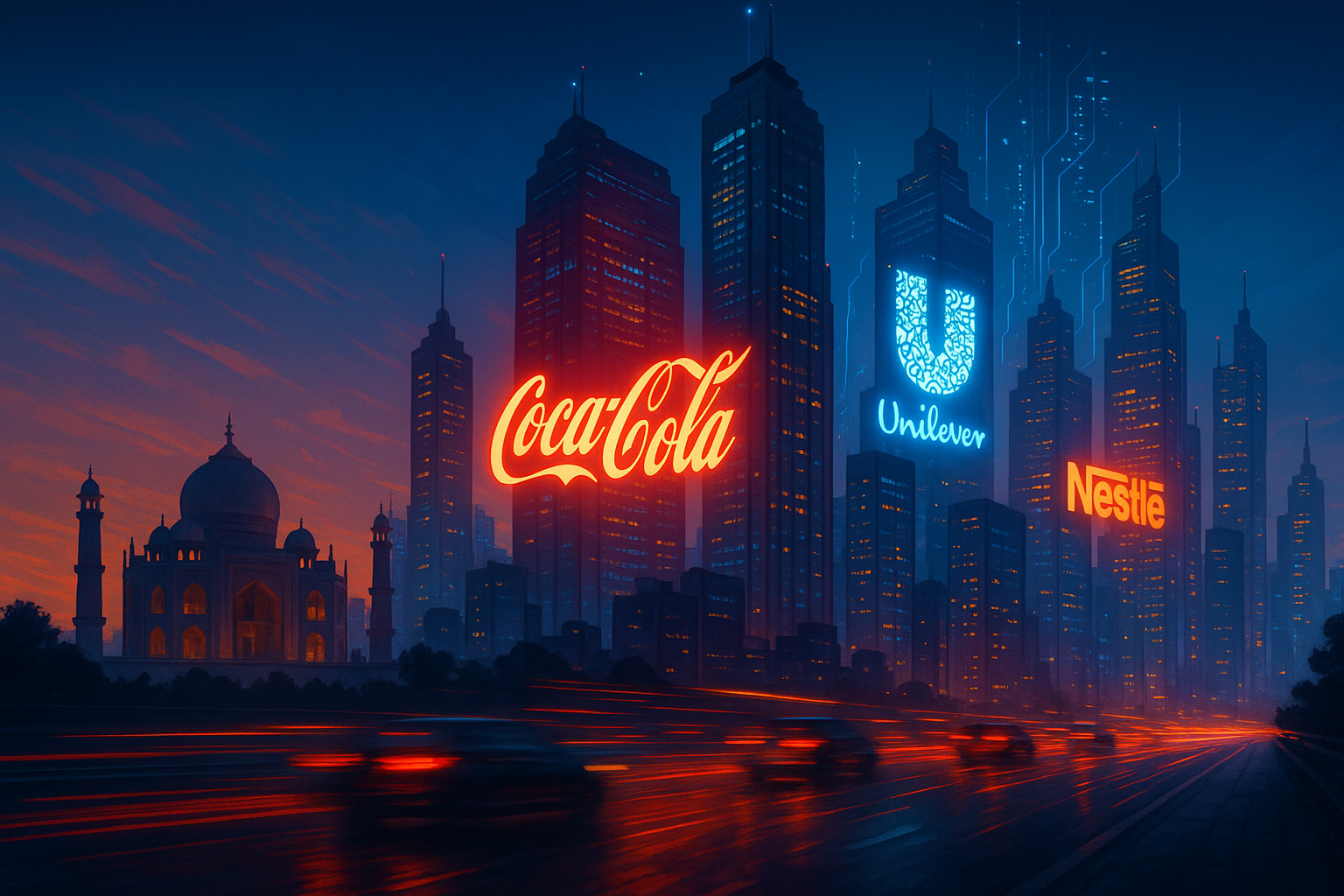
Introduction: India — The New Growth Engine for Global Consumer Majors
India has officially become the darling destination for global consumer multinationals (MNCs). From Unilever and Nestlé to Coca-Cola, PepsiCo, and Procter & Gamble (P&G), global giants are ramping up their investments, launching India-specific products, and expanding manufacturing bases to capture the next billion consumers.
In a world facing slowdowns in developed markets, India’s booming middle class, rapid urbanization, and digital transformation have turned the country into a goldmine for consumer MNCs.
According to industry data, India’s FMCG sector is projected to reach $220 billion by 2028, up from $115 billion in 2024 — a staggering double-digit CAGR of 14–15%.
🌍 Why India is the Bright Spot in a Cloudy Global Economy
While the U.S. and Europe grapple with inflationary pressures and stagnant consumption, India’s economy is firing on all cylinders. The IMF projects India’s GDP growth at 6.8% for FY2025, the fastest among major economies.
Key drivers attracting MNCs to India include:
- Rising disposable incomes: India’s middle class is expected to reach 700 million by 2030.
- Expanding rural consumption: 65% of India’s population resides in rural areas with growing purchasing power.
- Digital acceleration: Over 800 million internet users and a booming e-commerce ecosystem.
- Government initiatives: Schemes like Make in India, PLI (Production-Linked Incentives), and Digital India boost investor confidence.
Global companies see India not just as a market, but as a manufacturing hub and innovation lab for the future.
🏭 MNCs Accelerate Local Investments and Manufacturing
Several consumer giants are setting up new plants, R&D centers, and innovation hubs to strengthen their India presence.
- Nestlé India announced ₹5,000 crore investment to expand its manufacturing footprint by 2025.
- Hindustan Unilever (HUL) continues to launch rural distribution programs and digital-first campaigns to reach deeper markets.
- Coca-Cola has committed over ₹3,000 crore to boost its local production and cold-chain infrastructure.
- Procter & Gamble (P&G) unveiled a ‘Made in India for the World’ strategy to export from its Indian plants.
This shift marks a new era — India is no longer just a consumption market but a production powerhouse for the global supply chain.
💡 Innovation Tailored for Indian Consumers
Consumer MNCs are now designing products, flavors, and price points specifically for Indian consumers.
Examples include:
- PepsiCo introducing smaller ₹10 packs for Tier-2 and Tier-3 markets.
- Nestlé launching regional variants of Maggi noodles.
- Colgate-Palmolive developing Ayurvedic and herbal toothpaste lines to compete with local brands like Dabur and Patanjali.
- Unilever experimenting with sachet innovations for affordability and easy access.
This localization strategy is paying off — with double-digit volume growth reported by most MNCs in India despite global slowdowns.
📱 Digital India: The E-Commerce Catalyst
The rise of e-commerce and digital payments has created a new highway for MNCs to reach India’s 1.4 billion consumers.
Platforms like Amazon, Flipkart, Blinkit, Zepto, and BigBasket have changed how Indians shop for groceries and daily essentials. Even rural areas now contribute significantly to online orders.
MNCs are leveraging:
- AI-driven marketing to personalize consumer engagement.
- Omnichannel strategies combining online and offline retail.
- Influencer marketing and regional language content to reach younger audiences.
According to a RedSeer report, India’s D2C (Direct-to-Consumer) market will touch $100 billion by 2030, offering MNCs a massive new revenue stream.
📊 Sector Spotlight: FMCG, Beverages, and Personal Care Lead the Race
- FMCG Boom:
FMCG companies like HUL, ITC, and Nestlé continue to dominate, but competition from homegrown brands has forced innovation and efficiency. MNCs are now focusing on sustainability, packaging innovation, and affordable luxury segments. - Beverage Surge:
India’s beverage industry — both carbonated and non-carbonated — is witnessing a renaissance. Coca-Cola and PepsiCo are aggressively promoting fruit-based drinks and zero-sugar options, while homegrown rivals like Paper Boat and Parle Agro are expanding rapidly. - Personal Care Growth:
The beauty and personal care segment is exploding, with MNCs like L’Oréal, P&G, and Unilever introducing skincare and men’s grooming lines tailored for Indian consumers.
🌱 Sustainability Becomes the New Business Mantra
Environmental consciousness is no longer optional. MNCs are investing heavily in green packaging, renewable energy, and sustainable sourcing.
- Nestlé India aims to achieve 100% recyclable packaging by 2026.
- Unilever targets net-zero emissions by 2039.
- Coca-Cola has pledged to recover 100% of bottles sold in India.
These sustainability initiatives not only help in brand image building but also resonate deeply with India’s environmentally aware younger generation.
💼 Hiring and Skill Development Surge
With investments pouring in, job creation across manufacturing, marketing, and tech segments is booming.
MNCs are launching training programs and digital skill initiatives to groom local talent. For example:
- P&G’s “Shiksha” program focuses on education for underprivileged children.
- HUL’s Project Prabhat empowers rural entrepreneurs and women-led businesses.
India is witnessing the rise of a skilled consumer economy, and MNCs are leading from the front.
📈 Stock Market Outlook: Consumer MNCs Shine Bright
Investor sentiment around consumer MNCs remains bullish. FMCG and consumer discretionary stocks have consistently outperformed benchmark indices.
Analysts expect earnings momentum to stay strong given robust demand, easing raw material prices, and rural recovery.
Top performing MNC stocks in 2025 include:
- Hindustan Unilever (HUL)
- Nestlé India
- Colgate-Palmolive
- P&G Hygiene
- Britannia Industries
According to Motilal Oswal, the FMCG sector could deliver 15–18% annual returns over the next 3 years driven by premiumization and rural demand revival.
🧭 Challenges Ahead: Local Competition and Price Sensitivity
Despite the optimism, MNCs face several challenges in India:
- Fierce competition from agile domestic players like Dabur, Patanjali, ITC, and Marico.
- Price-sensitive consumers in lower-income segments.
- Complex distribution channels and rural logistics.
However, most global firms are adapting quickly by localizing supply chains, reducing input costs, and investing in digital distribution models to overcome these hurdles.
🏁 The Road Ahead: Fast Lane to $5 Trillion Economy
As India inches closer to becoming a $5 trillion economy by 2028, the consumer sector will be its fastest-growing engine. MNCs are gearing up for the long run — not just to sell but to build, innovate, and grow from India.
India is no longer an emerging market — it’s an emerging powerhouse, where the world’s biggest brands are finding their next billion customers and limitless growth potential.
🪄 Conclusion: India — The Future Epicenter of Global Consumption
Global consumer MNCs are no longer asking “Why India?” — the real question now is “How fast can we expand in India?”
With the perfect mix of demographics, digitalization, and disposable income, India is poised to become the world’s largest consumer market within the next decade.
And as the engines of growth roar louder, one thing is clear — for global giants, India isn’t just a destination… it’s the future.




Leave a Reply