


The Indian stock market is one of the fastest-growing in the world — with millions of investors joining every year.
But as the number of investors increases, so does the need for safety, transparency, and fair trading.
That’s where SEBI — the Securities and Exchange Board of India — comes in.
In this detailed article, we’ll explain what SEBI is, how it works, its powers, and why it plays such a crucial role in keeping India’s financial markets fair and stable.

💡 What Is SEBI?
SEBI (Securities and Exchange Board of India) is the regulatory authority that oversees and controls the securities market in India.
It was established in 1988 and given statutory powers on January 30, 1992, under the SEBI Act, 1992.
👉 Simply put:
SEBI is like a referee in a match — ensuring that brokers, investors, and companies follow the rules and no one cheats.
Its main job is to protect investors, promote fair trading, and develop the capital market.
🏛️ SEBI’s Headquarters and Structure
- Head Office: Mumbai (Bandra Kurla Complex)
- Regional Offices: Delhi, Chennai, Kolkata, and Ahmedabad
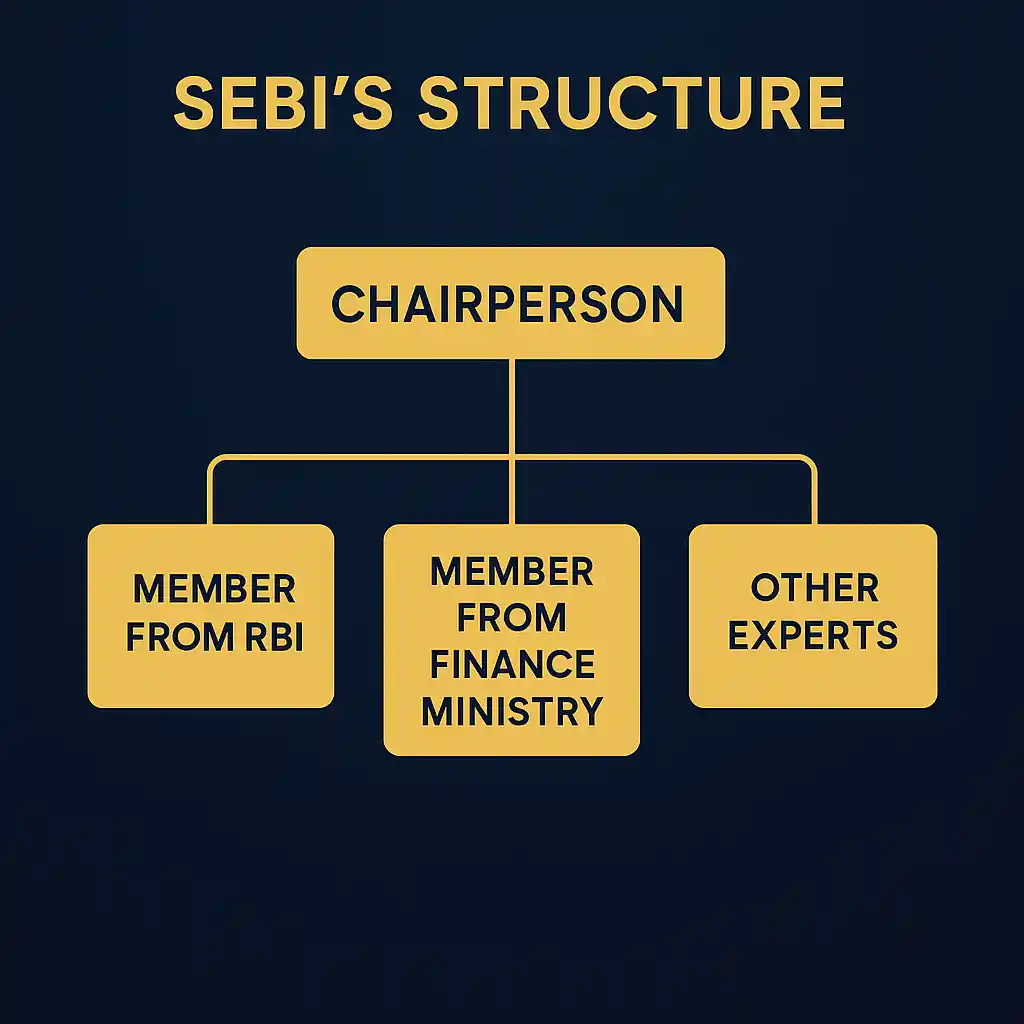
- Leadership: Headed by a Chairperson appointed by the Government of India
- Members: Includes representatives from:
- Reserve Bank of India (RBI)
- Finance Ministry
- Other experienced professionals from finance and law
This structure ensures that SEBI operates independently but under government oversight.
🎯 Main Objectives of SEBI
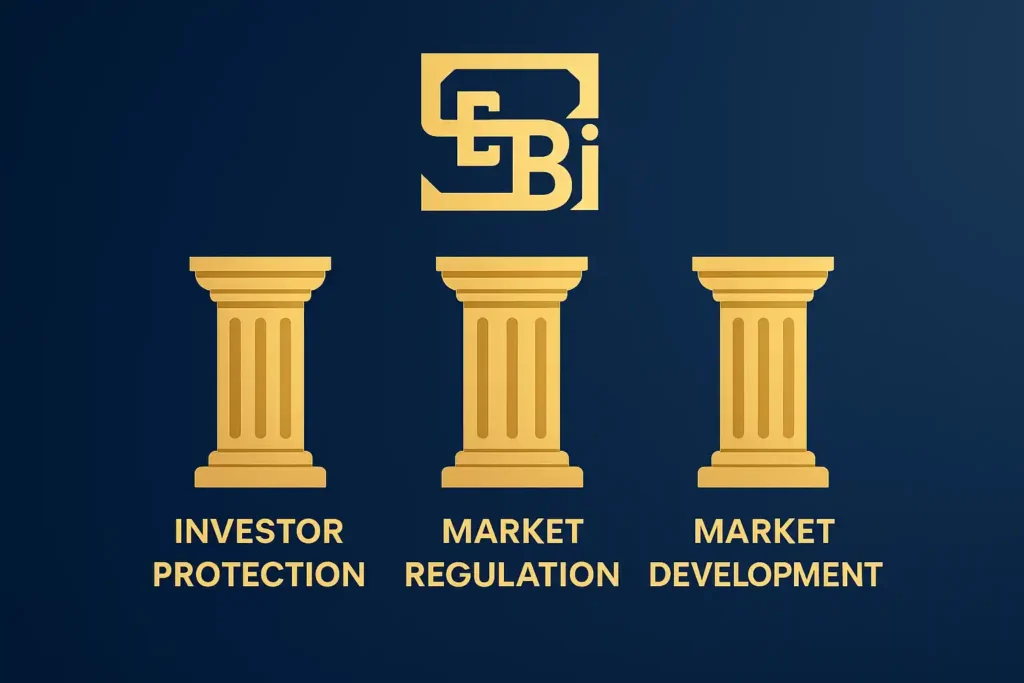
SEBI’s mission revolves around three core objectives, often called its “3 Pillars”:
| Objective | Description |
|---|---|
| 1. Protect Investors | Safeguard the interests of investors from fraud, insider trading, and misleading practices. |
| 2. Promote Development | Encourage the growth and modernization of the Indian capital market. |
| 3. Regulate the Market | Ensure smooth functioning, transparency, and fairness among market participants. |
These three pillars define every action SEBI takes.
⚙️ Why Was SEBI Formed?
Before SEBI existed, the Indian stock market was largely unregulated.
This led to major scams, manipulation, and insider trading during the 1980s.
The Harshad Mehta Scam (1992) was a major turning point — it exposed loopholes and showed the urgent need for a strong regulatory body.
Thus, SEBI was given legal powers through the SEBI Act, 1992, to control, supervise, and protect the Indian capital markets.

🧩 Functions of SEBI
SEBI performs three main categories of functions:
1. Protective Functions
To safeguard investors and maintain trust in the market:
- Prevent insider trading (illegal buying/selling based on secret information)
- Prohibit fraudulent practices
- Educate investors about risks and rights
- Ensure fair disclosures by listed companies
2. Regulatory Functions
To maintain order and transparency:
- Register and regulate stock brokers, mutual funds, and portfolio managers
- Set rules for company listings and IPOs
- Monitor takeovers and mergers
- Regulate depositories (NSDL, CDSL) and credit rating agencies
3. Developmental Functions
To modernize and develop the capital market:
- Promote electronic trading (online stock exchanges)
- Encourage investor education campaigns
- Simplify KYC and account opening
- Introduce reforms like T+1 settlement (faster trade processing)

🏦 Role of SEBI in the Indian Stock Market
Let’s break down SEBI’s real-world role in how the stock market functions daily 👇
1. Regulating Stock Exchanges
SEBI ensures exchanges like NSE and BSE follow fair and transparent trading rules.
It inspects their systems, prevents price manipulation, and ensures they function efficiently.
2. Monitoring Brokers and Intermediaries
All brokers, investment advisors, and portfolio managers must be registered with SEBI.
This reduces fraud and ensures investors deal only with trusted intermediaries.
3. Approving IPOs (Initial Public Offerings)
Before a company launches an IPO, SEBI reviews its documents (called DRHP) to ensure full disclosure and fair pricing.
This protects investors from being misled by inflated valuations.
4. Preventing Insider Trading
SEBI strictly monitors trading patterns to detect if any insider (like company employees) is trading based on secret information.
Violators face heavy penalties or bans.
5. Investor Education and Protection
SEBI runs awareness programs like:
- SCORES Portal – where investors can lodge complaints online
- SEBI Investor Awareness Campaigns – TV, radio, and digital sessions explaining market basics
6. Surveillance and Market Integrity
SEBI uses AI-driven surveillance systems to detect suspicious price movements or unusual trading volumes.
If manipulation is found, SEBI can suspend accounts, cancel trades, or penalize firms immediately.
🧠 SEBI’s Powers
SEBI holds both quasi-legislative, quasi-judicial, and quasi-executive powers — meaning it can make rules, enforce them, and take action.
| Power Type | Description |
|---|---|
| Legislative | Can create rules and regulations for all market participants. |
| Judicial | Can pass judgments and penalties in case of violations. |
| Executive | Can conduct inspections, collect data, and enforce actions. |
This combination makes SEBI one of the strongest financial regulators in India, similar to the SEC (U.S. Securities and Exchange Commission).
📊 SEBI’s Role in Major Reforms
SEBI has brought several reforms to modernize the Indian stock market:
- Introduction of Demat accounts (replacing paper share certificates)
- Online trading systems via NSE & BSE
- Mutual fund regulations ensuring transparency
- Takeover Code for mergers & acquisitions
- T+1 settlement cycle (fastest globally)
- Investor protection funds for compensating victims of broker defaults
These reforms have made India’s market more digital, transparent, and globally respected.
📉 Example of SEBI’s Intervention
In 2020, when a few small-cap companies were found inflating stock prices through fake news and circular trading, SEBI launched an investigation, froze their accounts, and refunded investors through investor protection mechanisms.
Such actions build confidence among small investors and maintain market integrity.
🧾 SEBI’s Role During Market Volatility
During major market events (like COVID-19 crash or 2023 banking shocks), SEBI:
- Imposes short-term restrictions on short-selling
- Tightens margin rules to prevent panic trading
- Coordinates with RBI and stock exchanges to maintain liquidity
This helps stabilize the market and prevents major collapses.
🧩 SEBI’s Relationship with Other Market Bodies
| Organization | Role | Relationship with SEBI |
|---|---|---|
| RBI | Regulates banking & monetary policy | Coordinates for liquidity & interest rates |
| IRDAI | Regulates insurance sector | Collaborates on investment norms |
| PFRDA | Regulates pension funds | Aligns policies for retirement investments |
| NSDL/CDSL | Manage Demat shares | SEBI supervises them |
| AMFI | Mutual fund industry body | Works under SEBI’s guidelines |
🔍 SEBI’s Major Guidelines for Investors
- Always trade with SEBI-registered brokers only.
- Check for company filings on SEBI’s website before investing.
- Avoid tips or unverified telegram channels.
- Use SCORES to report fraud or complaints.
- Never share your Demat login credentials or OTPs.

📚 SEBI’s Role in Investor Education
SEBI actively promotes financial literacy through:
- Online webinars and regional workshops
- School and college-level investor education programs
- Simplified publications like “Investor’s Guide to the Stock Market”
The goal: empower every Indian to become a confident investor.

⚖️ Recent SEBI Initiatives (2023–2025)
✅ T+1 Settlement — India became the first country to settle trades within 1 day.
✅ Online Mutual Fund Transactions via UPI — easier for small investors.
✅ AI-based Market Surveillance — detecting fraud in real time.
✅ Green Bond Guidelines — promoting sustainable investing.
🏁 Final Thoughts
SEBI is the backbone of India’s financial system.
It ensures that the stock market remains transparent, secure, and investor-friendly.
Without SEBI’s supervision, the Indian market could easily fall prey to fraud and manipulation — harming millions of investors.
So, whether you’re a beginner or an expert, always remember:
“A strong SEBI means a strong and trustworthy stock market.” 💼📈










Leave a Reply