


Momentum investing is one of the most popular and powerful investing and trading strategies used worldwide. Unlike value or fundamental investing, momentum investing focuses on one core idea:
Stocks that are already rising tend to keep rising, and stocks that are falling tend to keep falling.
This strategy is based on short-term and medium-term trends and is widely used by hedge funds, algorithmic traders, and momentum ETFs.
In this guide, you will learn exactly how momentum investing works, which indicators matter, how to identify high-momentum stocks, and how to apply a safe and effective momentum strategy in 2025.
2. What Is Momentum Investing?
Momentum investing is a strategy where investors buy stocks that have shown strong upward movement and sell stocks that have shown downward price momentum.
Core Principle
Price movement attracts more price movement.
This happens due to:
- Market psychology
- Institutional buying
- Trend continuation
- Breakout patterns
- High volume confirmation
Momentum investing focuses more on price action rather than company fundamentals.
3. How Momentum Investing Works

Momentum investors identify stocks that:
- Are already in a strong uptrend
- Have rising volumes
- Are outperforming their sector or index
- Are breaking key resistance levels
- Have strong relative strength over time
Once identified, investors ride the trend until momentum weakens.
Time Horizons for Momentum Investing
- Short Term: 1–8 weeks
- Medium Term: 2–12 months
- Long Term Momentum (Rare): 1–3 years
Most momentum strategies work best in bull markets, but disciplined techniques help in all market phases.
4. Why Momentum Investing Works
There are several psychological and structural reasons why momentum continues even after a stock has moved significantly.
1. Herd Behavior
Investors follow trends, leading to more buying when prices rise.
2. Institutional Activity
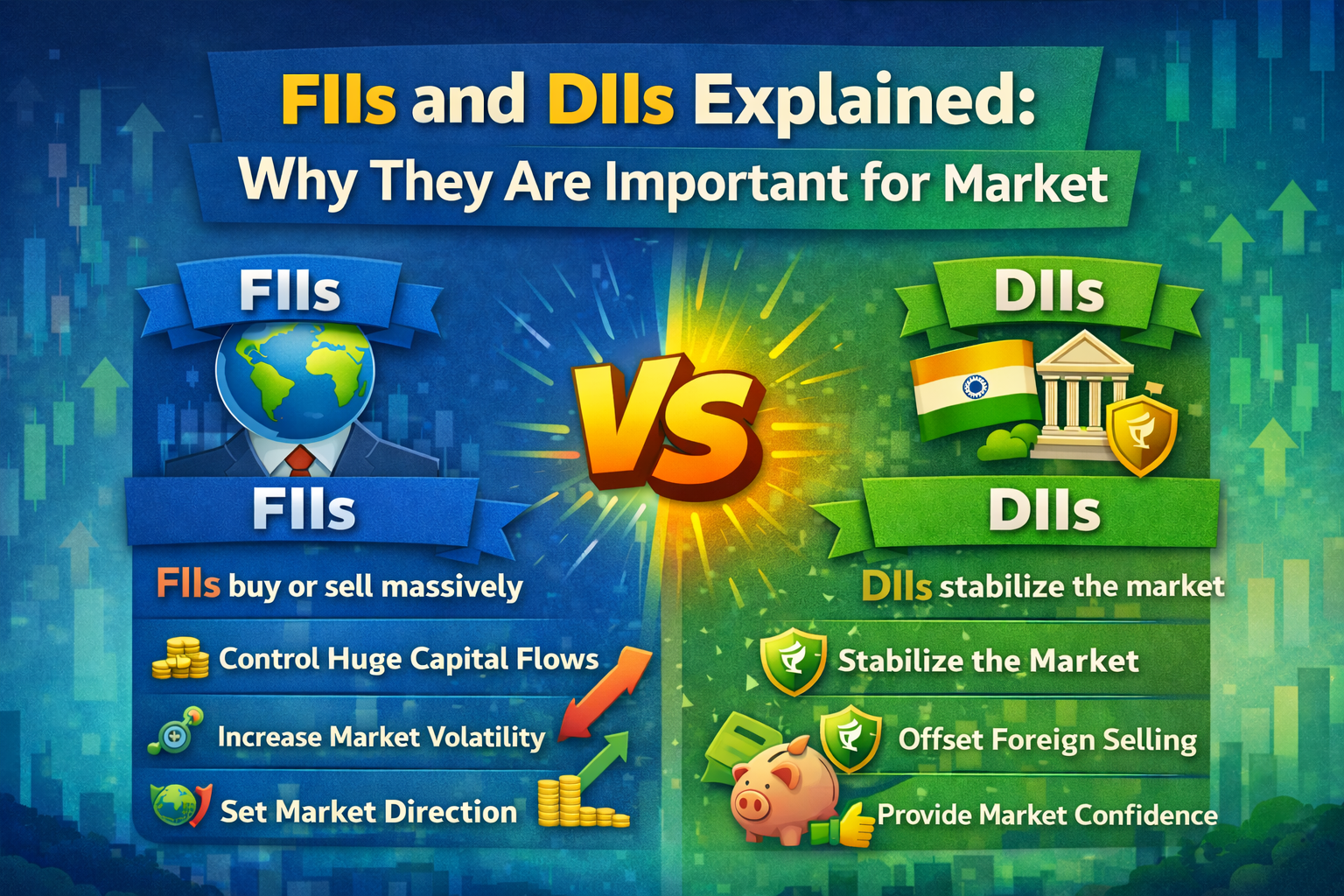
Mutual funds, hedge funds, and FIIs accumulate trending stocks.
3. Strong Earnings Support
Companies that outperform earnings often experience multi-month momentum.
4. Breakout Traders
Technical traders enter aggressively after a breakout.
5. Market Fear of Missing Out (FOMO)
Demand increases as more traders notice the trend.
These factors make momentum investing extremely powerful when done correctly.
5. Indicators Used in Momentum Investing
Momentum investing depends heavily on technical indicators.
Here are the most reliable ones:
1. Relative Strength Index (RSI)
- Measures the speed of price movement
- Strong momentum: RSI between 60–80
- Weak momentum: RSI below 50
2. Moving Averages (21, 50, 100, 200 DMA)
A stock above its major moving averages indicates strong momentum.
3. MACD (Moving Average Convergence Divergence)
Confirms trend direction and strength.
4. Rate of Change (ROC)
Helps measure percentage price movement over time.
5. Volume Analysis
Price movement supported by rising volume is a key momentum signal.
6. Relative Strength (RS Rating)
Compares stock performance against Nifty/S&P500.
A stock with RS rating above 70 is usually considered high-momentum.
6. How to Build a Momentum Investing Strategy in 2025
Here is a step-by-step blueprint.
Step 1: Scan for Strong Trending Stocks
Look for stocks that:
- Have gained 20–30% or more in the last 12 weeks
- Are consistently closing above major moving averages
- Belong to outperforming sectors (IT, EV, Pharma, AI, etc.)
- Have increasing volume
Step 2: Confirm Trend Strength
Use indicators:
- RSI above 60
- MACD crossover confirmation
- Price above 50 DMA and 200 DMA
- Strong candle breakouts
Step 3: Identify Entry Points
Best entry setups include:
- Breakout from major resistance
- Pullback near moving averages
- Volume expansion days
- Bullish engulfing or trend continuation patterns
Step 4: Position Sizing and Risk Management
Momentum investing requires strict risk control.
- Risk per trade: 1–2%
- Use stop loss below support
- Never average down in momentum trades
Step 5: Exit Strategy
Exit when:
- RSI falls below 50
- Price breaks below 50-Day Moving Average
- MACD gives bearish crossover
- Volume drops significantly
- Trend reverses (lower highs and lower lows)
Momentum investors should accept early exit and avoid holding during reversals.
7. Advantages of Momentum Investing
- Simple to understand and execute
- Works extremely well in trending markets
- Quick returns compared to value investing
- No need for deep fundamental analysis
- Can be automated through scanners and algorithms
8. Risks of Momentum Investing
Momentum investing is powerful, but risky if undisciplined.
- Highly volatile
- Sharp reversals during market corrections
- Difficult to apply in sideways markets
- Requires strict stop-loss
- Overtrading risk
- Emotional decisions during swings
Without risk control, traders can lose momentum profits quickly.
9. Who Should Use Momentum Investing?
Momentum investing suits:
- Active traders
- Medium-term swing traders
- Investors comfortable with volatility
- Those who understand technical charts
- Traders who prefer faster results
Not suitable for extremely conservative or passive investors.
10. Momentum Investing vs Other Strategies
| Strategy | Style | Risk | Return Speed |
|---|---|---|---|
| Value Investing | Low | Low | Slow |
| Growth Investing | Medium | Medium | Fast |
| Momentum Investing | Technical | High | Very Fast |
| Index Investing | Passive | Low | Slow |
Momentum investing offers the fastest return potential but requires the highest discipline.
11. Best Market Conditions for Momentum Investing in 2025
Momentum performs best when:
- Markets are trending upward
- Interest rates stabilize
- Strong earnings seasons
- High sector rotation
- Increased FPI/FII flows
Based on 2025 forecasts, momentum investing is expected to perform strongly in technology, AI, electric vehicles, and capital goods sectors.
12. Conclusion
Momentum investing is one of the most effective strategies for capturing short-term and medium-term trends in the stock market. While it offers high return potential, it requires discipline, risk management, and understanding of technical indicators.
If used properly, momentum investing can significantly outperform traditional strategies in trending markets.










Leave a Reply