

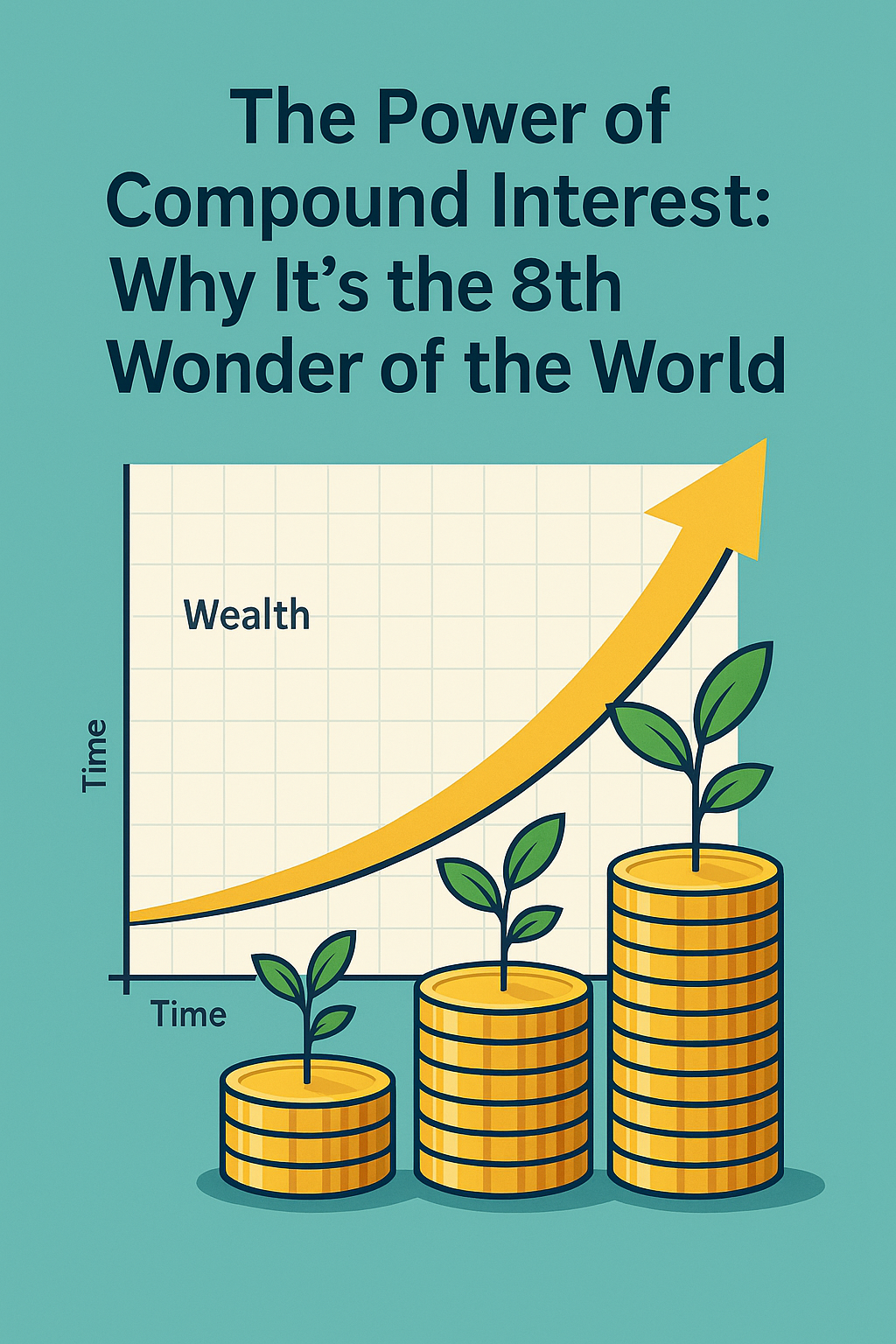
Introduction: The Magic Behind Compound Interest
In the world of finance and investing, there’s one concept that consistently turns small savings into large fortunes — Compound Interest. Albert Einstein famously called it the “8th Wonder of the World”, saying, “He who understands it, earns it; he who doesn’t, pays it.”
But what exactly is compound interest, and why does it hold such legendary status among investors, economists, and financial advisors?
Let’s break down this “financial superpower” and understand how it can work wonders for your wealth — especially if you start early.
What Is Compound Interest?
In simple terms, compound interest means earning interest on both your initial investment (principal) and the interest you’ve already earned.
Unlike simple interest, where you earn interest only on the original amount, compound interest accelerates your money’s growth because it keeps adding interest to your balance over time — a process known as compounding.
Compound Interest Formula:
A=P×(1+rn)n×tA = P \times (1 + \frac{r}{n})^{n \times t}A=P×(1+nr)n×t
Where:
- A = Final amount after time t
- P = Principal (initial investment)
- r = Annual interest rate (in decimal)
- n = Number of times interest is compounded per year
- t = Time in years
Example:
If you invest ₹1,00,000 at 10% annual interest compounded yearly for 10 years: A=1,00,000×(1+0.10)10=₹2,59,374A = 1,00,000 \times (1 + 0.10)^{10} = ₹2,59,374A=1,00,000×(1+0.10)10=₹2,59,374
You earned ₹1,59,374 in interest — far higher than the ₹1,00,000 you’d earn with simple interest.
Why Compound Interest Is Called the “8th Wonder of the World”
Einstein’s statement wasn’t an exaggeration. The exponential power of compound interest makes it one of the most powerful forces in finance.
1. It Rewards Time, Not Timing
In investing, time is your biggest ally. The earlier you start, the greater the compounding effect.
For instance, someone investing ₹5,000 monthly from age 25 to 35 (10 years) could have more money at 60 than someone who starts at 35 and invests ₹5,000 monthly for 25 years — all because the first investor gave compounding more time to grow.
2. It Turns Small Steps into Giant Leaps
Even small investments can grow into massive sums when left untouched. That’s why financial planners often say:
“Don’t wait to invest — invest, then wait.”
3. It Works Silently and Consistently
You don’t have to trade daily or time the market. Once your money is invested in a compounding instrument — like mutual funds, fixed deposits, or retirement plans — it keeps growing passively.
The Psychology Behind Compound Interest
The concept is simple but counterintuitive. Human minds are wired to think linearly, not exponentially.
For example, doubling a number 10 times (2¹⁰ = 1,024) seems small on paper but is actually over 1,000 times bigger than the starting value!
This psychological bias makes people underestimate compounding. But in reality, it’s the difference between financial independence and lifelong dependency.
How Compound Interest Works in Real Life
1. In Bank Savings Accounts
When you deposit money in a savings or fixed deposit account, the bank pays you interest. If this interest is added back to your balance and earns more interest, that’s compounding at work.
2. In Mutual Funds and SIPs
Systematic Investment Plans (SIPs) are among the best examples of compound growth. Your monthly investments buy mutual fund units, and as those funds appreciate, your returns also earn returns.
For example, investing ₹10,000 monthly at 12% annual returns for 20 years grows to over ₹99 lakhs — even though you invested only ₹24 lakhs.
3. In Retirement Accounts
Pension funds, NPS (National Pension System), and PPF (Public Provident Fund) all rely on compounding to multiply your savings over decades.
4. In Stock Market Investments
Reinvesting dividends into shares accelerates compounding. The longer you hold high-quality stocks, the greater your returns from both capital appreciation and dividend reinvestment.
Simple vs Compound Interest: The Clear Difference
| Feature | Simple Interest | Compound Interest |
|---|---|---|
| Interest Calculation | On principal only | On principal + accumulated interest |
| Growth Type | Linear | Exponential |
| Returns Over Time | Fixed | Increasing |
| Best For | Short-term loans | Long-term investments |
| Example (₹1 lakh @ 10% for 10 years) | ₹2,00,000 total | ₹2,59,374 total |
Clearly, compound interest outperforms simple interest every time — especially over long periods.
The Rule of 72 — Estimate Your Doubling Time
Here’s a quick mental trick to estimate how long it takes to double your money with compound interest. \text{Time (years)} = \frac{72}{\text{Interest Rate (%)}}
- At 6% interest → 72 ÷ 6 = 12 years
- At 12% interest → 72 ÷ 12 = 6 years
So, at a 12% annual return (like a good mutual fund), your money doubles roughly every 6 years!
The Power of Starting Early
To illustrate the magic of time:
| Investor | Monthly Investment | Duration | Annual Return | Total Invested | Corpus at Age 60 |
|---|---|---|---|---|---|
| A (Starts at 25) | ₹5,000 | 35 years | 12% | ₹21 lakhs | ₹2.7 crores |
| B (Starts at 35) | ₹5,000 | 25 years | 12% | ₹15 lakhs | ₹85 lakhs |
Even though Investor A invested only ₹6 lakhs more, their final corpus is over 3 times larger because of compounding!
How to Use Compound Interest to Build Wealth
1. Start Early
The earlier you invest, the more time compounding has to multiply your wealth. Even small SIPs started in your 20s can lead to huge sums in your 50s.
2. Stay Invested Long-Term
Don’t withdraw your earnings frequently. Let your money grow uninterrupted for decades to achieve exponential returns.
3. Reinvest Your Returns
Always reinvest dividends and interest. That’s how you create “interest on interest” — the essence of compounding.
4. Choose High-Compounding Instruments
Opt for long-term instruments such as:
- Equity mutual funds
- NPS or PPF
- Dividend reinvestment plans
- Index funds and ETFs
5. Avoid Debt That Compounds Against You
Remember: compounding also works against you if you carry debt like credit cards or personal loans. Interest compounds in reverse, making it harder to repay.
So, avoid high-interest liabilities and focus on assets that compound for you.
Real-World Example: Warren Buffett’s Fortune
The world’s most successful investor, Warren Buffett, built his fortune almost entirely through the power of compounding.
Over 99% of his wealth came after age 50, proving that time and consistency — not luck — are the real wealth multipliers.
He once said:
“My wealth has come from a combination of living in America, some lucky genes, and compound interest.”
The Double-Edged Sword: Compounding Debt
While compounding is a blessing when investing, it’s a curse when borrowing.
Credit card companies use the same principle to keep customers trapped in debt. Missing even one payment can lead to interest on interest, ballooning your balance.
Tip: Always pay off high-interest debt first before you start investing.
The Emotional Side of Compounding
Compounding requires patience and discipline — qualities many investors lack.
In an era of instant gratification, compounding rewards those who wait, reinvest, and stay consistent.
Think of it like growing a tree. In the early years, it grows slowly. But after a decade, it suddenly seems unstoppable — just like your portfolio after years of consistent compounding.
Common Myths About Compound Interest
Myth 1: You Need a Lot of Money to Start
Fact: You can start with as little as ₹500 per month in SIPs. What matters is consistency and time.
Myth 2: It Works Only in the Stock Market
Fact: Compounding applies to any interest-bearing or reinvested return — FDs, PPF, bonds, or stocks.
Myth 3: Compounding Is Slow
Fact: In the beginning, growth looks slow, but it accelerates dramatically later — the “snowball effect.”
Practical Tools to Calculate Compound Interest
You can use these tools to plan and track your investments:
- Compound Interest Calculator (MyStockBazaar.com tool)
- SIP Return Calculator
- Rule of 72 Estimator
- Retirement Corpus Planner
These calculators help visualize how your money grows each year — motivating you to stay invested longer.
Final Thoughts: Let Time Work for You
Compound interest is not just a financial formula — it’s a philosophy of wealth creation.
The secret lies in starting early, staying consistent, and letting time do the heavy lifting. Whether you’re investing in mutual funds, the stock market, or retirement plans, compounding is your greatest ally.
At MyStockBazaar, we believe that understanding compound interest is the first step toward financial freedom. Once you harness its power, you’ll realize why it truly deserves to be called the 8th Wonder of the World.








Leave a Reply