

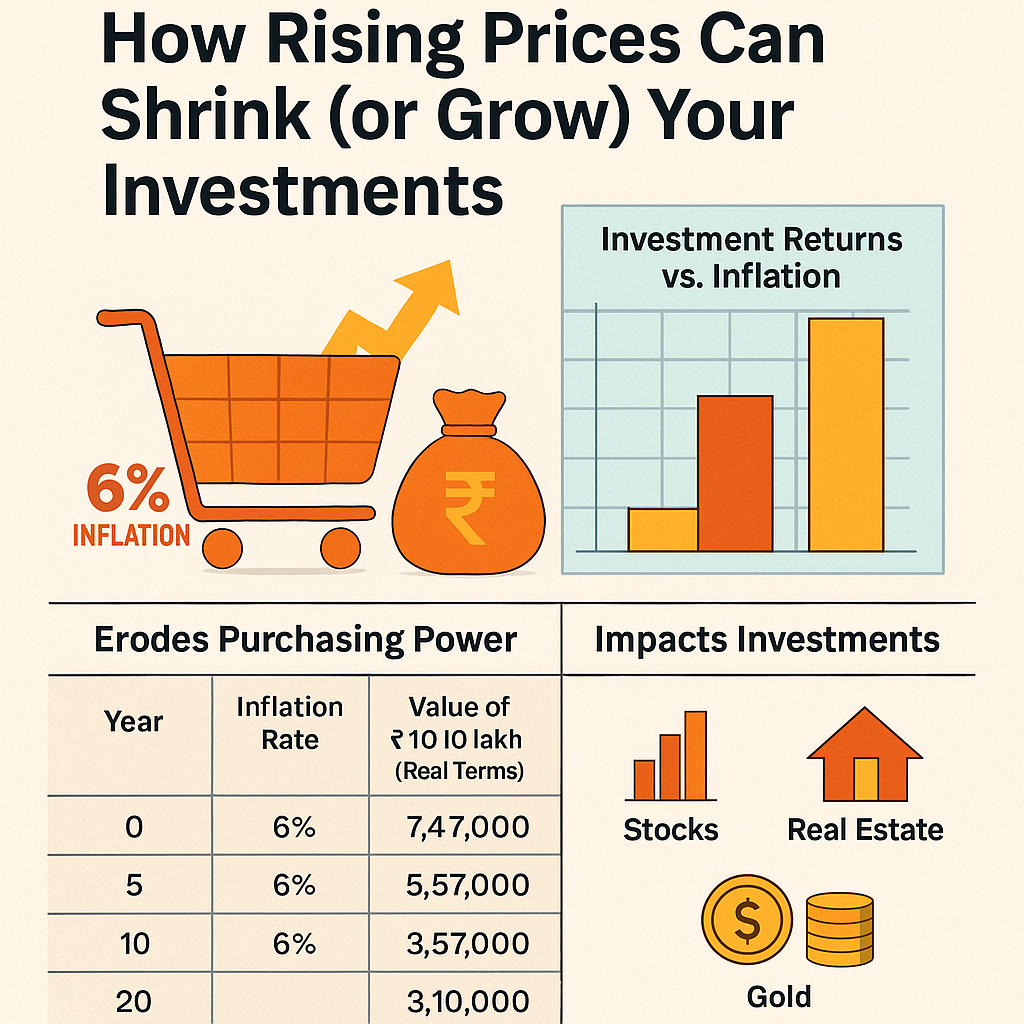
Discover how inflation quietly erodes your purchasing power — and learn how smart investors beat it with the right investment strategies. Understand inflation’s impact on stocks, gold, real estate, and mutual funds at MyStockBazaar.com.
Introduction: The Silent Wealth Killer
Inflation is often called the silent killer of wealth — and for good reason.
While we notice rising prices of fuel, groceries, and rent, few realize how inflation quietly reduces the real value of money — and, by extension, the returns on your investments.
In simple terms, inflation means that tomorrow’s money buys less than today’s. Even if your savings grow at 6% per year, if inflation runs at 7%, you’re actually losing 1% in real terms.
So, understanding inflation — and how to outpace it — is crucial for every investor.
Let’s explore what inflation is, why it happens, and how it affects your investments across different asset classes.
What Is Inflation?
Inflation is the rate at which the general level of prices for goods and services rises, reducing purchasing power.
In India, inflation is typically measured by the Consumer Price Index (CPI), which tracks the price changes in a basket of everyday items — like food, housing, clothing, and fuel.
Example:
If inflation is 6%, what cost ₹100 today will cost ₹106 next year.
That means your ₹100 will be worth less in terms of what it can buy.
The Root Causes of Inflation
Inflation doesn’t happen randomly. It’s influenced by several key factors:
1. Demand-Pull Inflation
When demand for goods exceeds supply — such as during festive seasons or economic booms — prices rise. Think of it as too much money chasing too few goods.
2. Cost-Push Inflation
When production costs (like wages, fuel, or raw materials) increase, companies pass those costs to consumers — raising prices.
3. Monetary Policy & Excess Money Supply
When central banks, like the RBI, print more money or keep interest rates too low for too long, inflation often follows.
4. Global Factors
Geopolitical conflicts, supply chain disruptions, or oil price hikes also fuel inflation — as seen after the Russia-Ukraine war and pandemic.
How Inflation Impacts Your Investments
Inflation doesn’t just affect your grocery bills — it can reshape your entire investment portfolio. Here’s how it influences major asset classes:
1. Savings & Fixed Deposits (FDs)
Your bank FD might offer 6–7% returns, but if inflation runs at 6.5%, your real return is nearly zero.
That’s why relying solely on fixed deposits or savings accounts can be risky in the long term — your money’s purchasing power steadily declines.
Tip: Use FDs for short-term goals, not wealth creation.
2. Bonds and Fixed-Income Investments
Bond prices have an inverse relationship with interest rates.
When inflation rises, central banks increase interest rates to control it — causing bond prices to fall.
So, if you hold long-term bonds, their market value may decline during high inflation periods.
Better Option: Short-duration or inflation-indexed bonds during inflationary phases.
3. Stock Market (Equities)
Stocks are often seen as a natural hedge against inflation, but it’s not always straightforward.
- Moderate inflation can boost company revenues (as prices rise).
- High inflation, however, increases costs (wages, raw materials, borrowing), squeezing profit margins.
Sectors like FMCG, utilities, and energy tend to perform better during inflation since they can pass costs to consumers.
But sectors like IT and manufacturing may struggle when inflation spikes.
Investor Strategy:
Invest in quality companies with strong pricing power and low debt — they can handle inflation shocks better.
4. Gold and Precious Metals
Gold has long been called the “inflation hedge” — and for good reason.
When inflation rises, investors lose confidence in paper money and flock to gold, which retains value.
Over decades, gold has preserved purchasing power better than cash or FDs.
However, it doesn’t generate income — so it’s best as a diversification tool, not your primary investment.
5. Real Estate
Real estate often appreciates alongside inflation.
As construction costs and property demand rise, prices tend to increase — making real estate a tangible inflation hedge.
However, liquidity, maintenance costs, and interest rate sensitivity (on home loans) must be considered.
6. Mutual Funds
Mutual funds — especially equity and hybrid funds — can help you beat inflation in the long term.
A diversified SIP (Systematic Investment Plan) earning 12–14% per year comfortably outpaces average inflation of 5–6%.
Even debt mutual funds can perform better than fixed deposits when managed smartly during changing interest rate cycles.
Inflation’s Effect on Purchasing Power
Let’s see how inflation eats away your money over time:
| Year | Inflation Rate | Value of ₹10 lakh (Real Terms) |
|---|---|---|
| 0 | — | ₹10,00,000 |
| 5 | 6% | ₹7,47,000 |
| 10 | 6% | ₹5,57,000 |
| 20 | 6% | ₹3,10,000 |
In 20 years, your ₹10 lakh will lose nearly 70% of its purchasing power if left idle in cash or low-yield accounts.
That’s the silent damage inflation does if you don’t invest strategically.
How to Beat Inflation Through Smart Investing
You can’t control inflation — but you can control how you respond to it.
Here’s how to protect and grow your wealth even when prices rise.
1. Invest in Equities Early and Consistently
Equities outperform inflation over the long term.
Even during inflationary cycles, companies with pricing power — such as FMCG, energy, and infrastructure — can deliver strong returns.
Start SIPs in diversified equity mutual funds or index funds and stay invested for 10–20 years to harness compounding.
2. Diversify Your Portfolio
Don’t rely on a single asset class.
A balanced portfolio might look like this:
- 60% Equities (stocks or equity mutual funds)
- 20% Debt (bonds, debt funds)
- 10% Gold or silver
- 10% Real estate or REITs
This mix cushions inflation impact while maximizing growth potential.
3. Choose Inflation-Protected Investments
Look for inflation-indexed bonds (IIBs) or floating-rate funds — their returns rise with inflation, keeping your purchasing power intact.
Some countries issue Treasury Inflation-Protected Securities (TIPS); in India, RBI bonds and debt mutual funds can offer similar benefits.
4. Reinvest Returns and Stay Long-Term
Inflation punishes short-term savers but rewards patient investors.
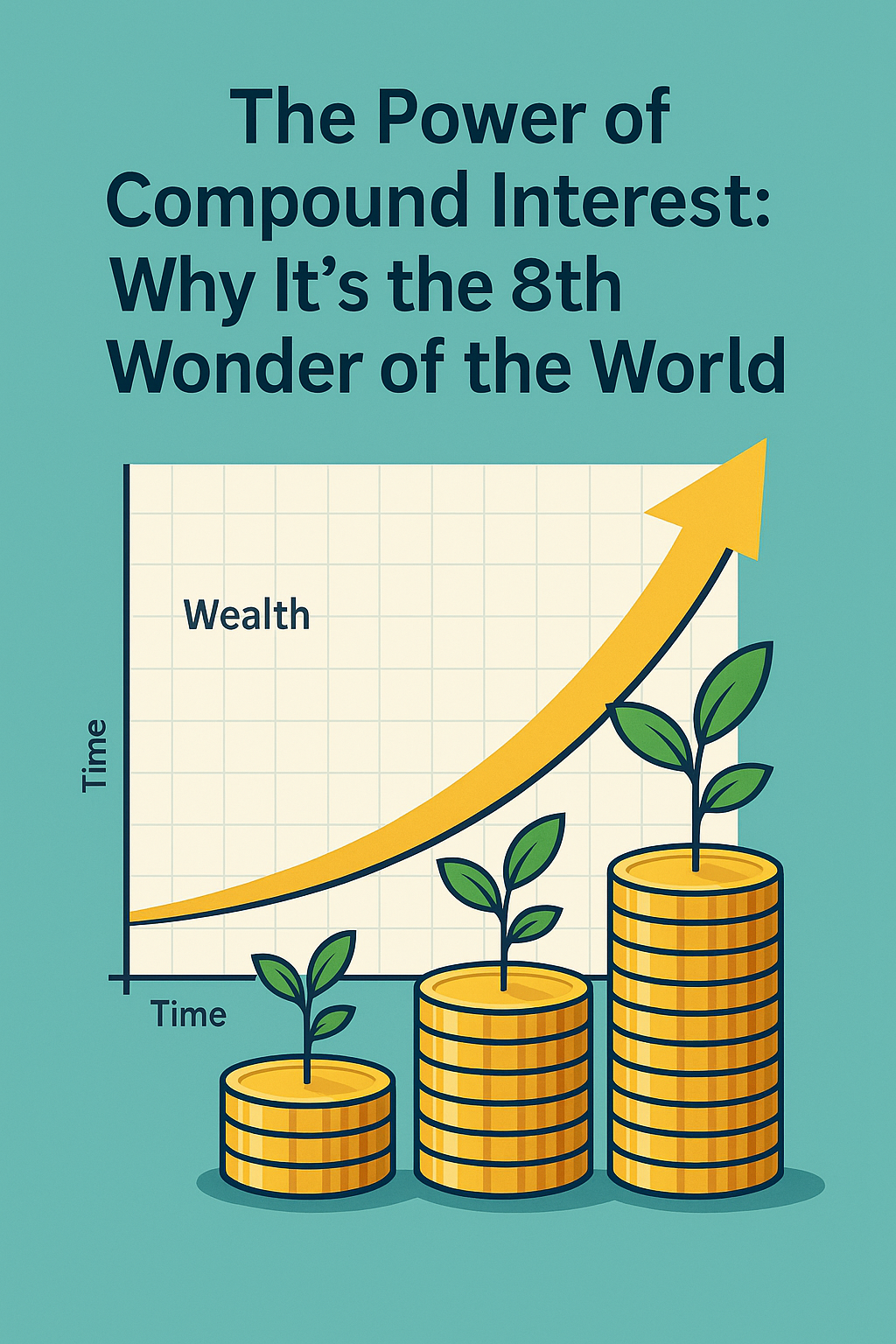
Reinvest your dividends and interest — and let compound growth outpace inflation over time.
5. Focus on Real Returns, Not Nominal Returns
If your investment earns 8% and inflation is 6%, your real return is only 2%.
So always measure your performance after adjusting for inflation.
Inflation’s Bright Side: Opportunities for Investors
While inflation often sounds negative, it also creates opportunities.
- Commodity Stocks: Oil, metals, and agriculture companies benefit from rising prices.
- Banks and NBFCs: Higher rates can improve margins for lenders.
- REITs: Real Estate Investment Trusts often gain as property values and rents rise.
So, inflation doesn’t have to be your enemy — if you know where to invest.
Inflation, Interest Rates, and Market Cycles
Inflation and interest rates are closely linked.
When inflation rises, central banks hike rates to cool demand — impacting loans, EMIs, and market sentiment.
But when inflation falls, central banks cut rates — boosting borrowing, spending, and market growth.
Investors who understand this cycle can reposition their portfolios effectively — moving between equity, debt, and commodities based on inflation trends.
Real-Life Example: Inflation During COVID and Beyond
Between 2020–2023, global inflation surged due to supply chain breakdowns, stimulus spending, and oil shocks.
In India, CPI inflation hovered around 6–7%, while FD rates were barely 5%.
Investors who stayed in equities or gold outperformed inflation easily, while those holding cash saw their value decline.
This real-world example underscores why inflation awareness is essential for every investor.
Final Thoughts: Don’t Let Inflation Eat Your Future
Inflation is inevitable — but losing to it isn’t.
By investing smartly, diversifying your assets, and focusing on inflation-beating returns, you can protect and grow your wealth over time.
At MyStockBazaar.com, we help you understand the financial forces that shape your money — and teach you how to make inflation work for you, not against you.
Remember:
“Inflation is not your enemy if you invest in assets that grow faster than prices.”











Leave a Reply