


When you first step into the world of investing, the stock market can feel like a different language altogether — words like bullish, IPO, P/E ratio, and market cap are thrown around everywhere.
Don’t worry bhai, every expert investor once started where you are today. Understanding these terms is the first step toward becoming a confident investor.
Let’s break down the most important stock market terminologies every new investor must know — in simple, real-world language 👇
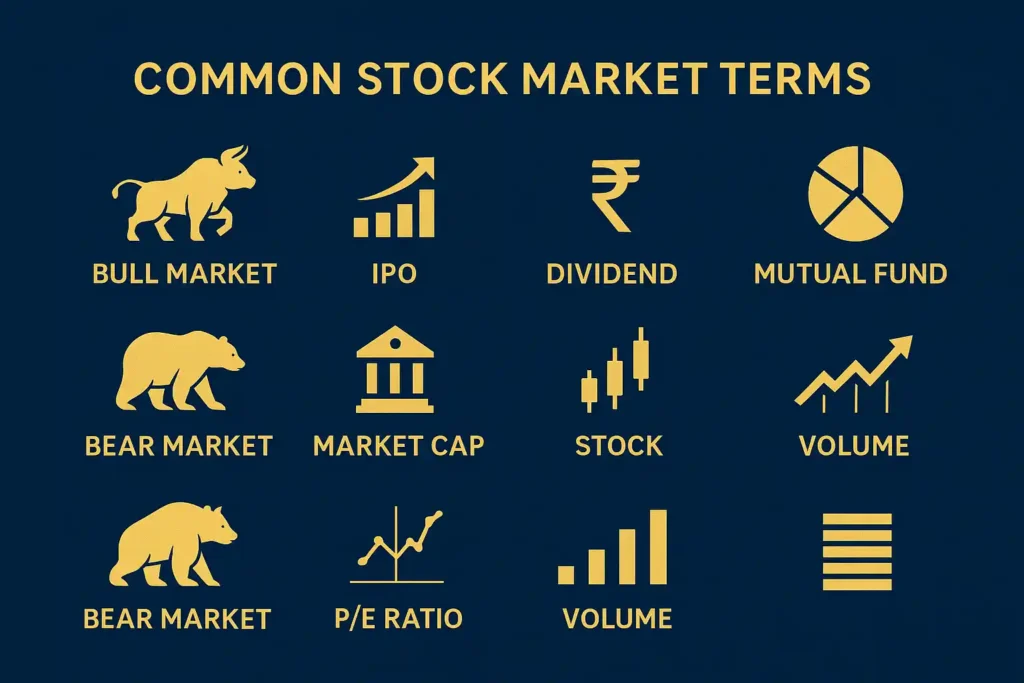
💡 1. Stock / Share
A stock or share represents ownership in a company.
When you buy a share of a company, you own a small portion of that company.
📘 Example:
Buying 100 shares of Infosys means you own a part of Infosys Ltd.
💰 2. IPO (Initial Public Offering)
An IPO is when a company sells its shares to the public for the first time to raise funds.
After the IPO, its shares get listed on stock exchanges like NSE or BSE.
📘 Example:
When LIC launched its IPO, investors got a chance to become shareholders of LIC.
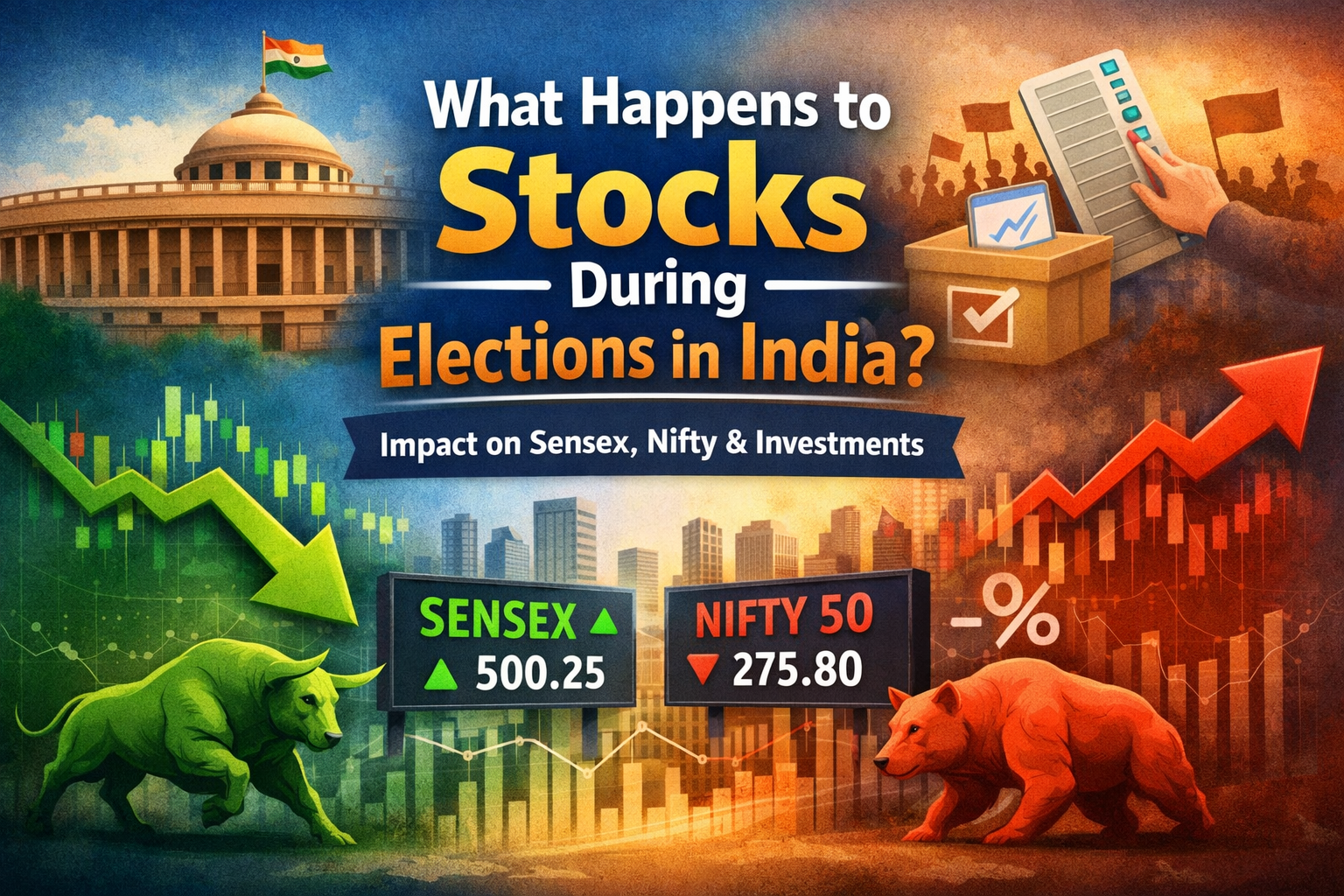
📈 3. Bull Market
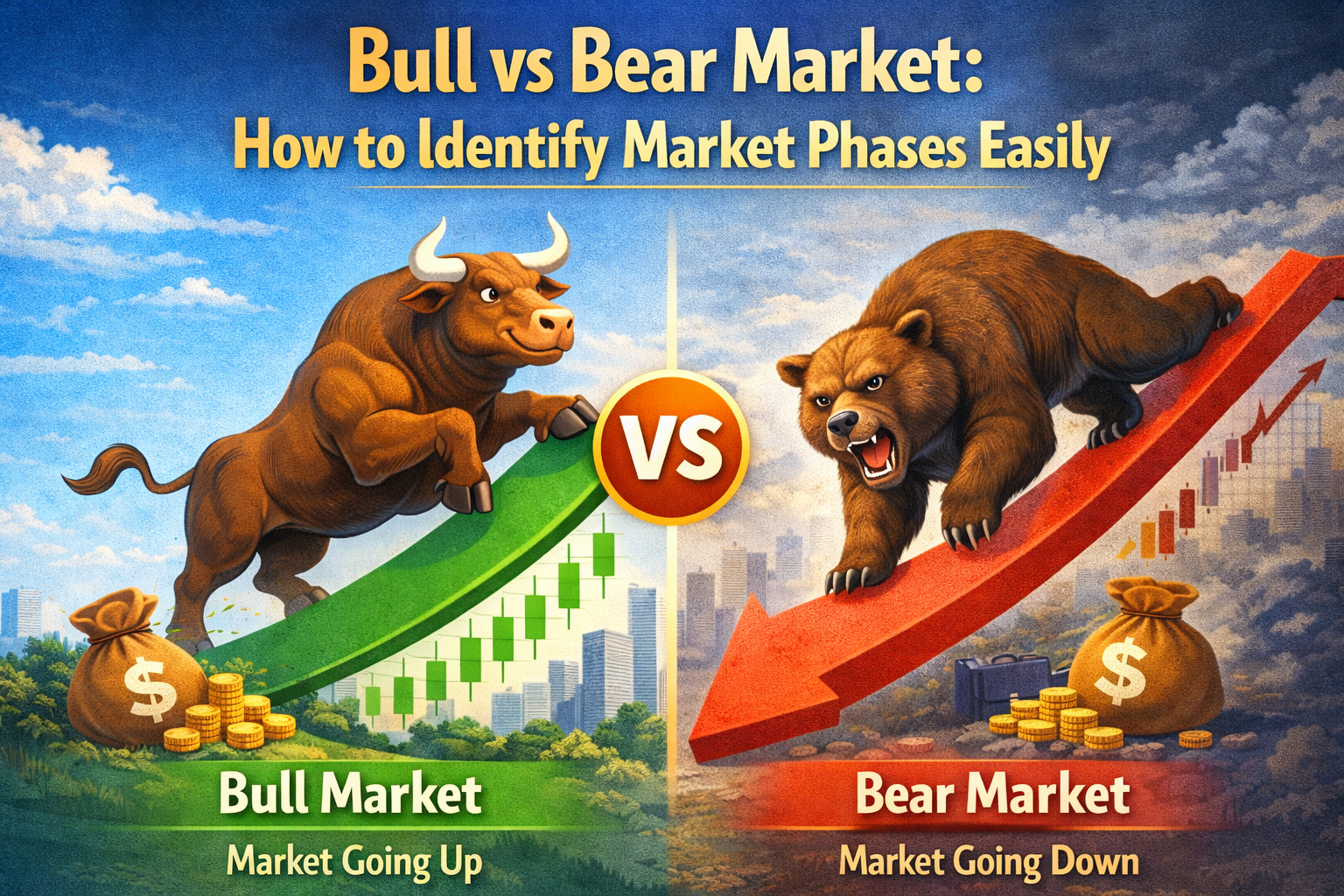
A bull market means prices of most stocks are rising.
It represents investor optimism, high confidence, and positive economic conditions.
📉 Opposite: Bear Market (when stock prices fall continuously).
🐻 4. Bear Market
A bear market is the opposite of a bull market — when stock prices fall by more than 20% for a prolonged period.
Investors feel fear and start selling stocks to avoid losses.
📊 5. Market Capitalization (Market Cap)
It’s the total value of a company’s outstanding shares.
📘 Formula:
Market Cap = Share Price × Total Shares Outstanding
- Large-cap: ₹20,000 crore+ (TCS, Reliance)
- Mid-cap: ₹5,000 – ₹20,000 crore
- Small-cap: < ₹5,000 crore
📋 6. Demat Account
A Demat (Dematerialized) account holds your shares in digital format — just like a digital locker.
It’s essential for every investor to buy or sell shares.
⚙️ 7. Trading Account
A trading account is what you use to buy or sell shares on the stock exchange.
It connects your Demat and bank accounts.
🧾 8. Index
An index is a group of selected stocks representing the performance of a segment of the market.
📘 Examples:
- NIFTY 50 (top 50 NSE companies)
- SENSEX (top 30 BSE companies)
🏦 9. NSE & BSE
- NSE (National Stock Exchange)
- BSE (Bombay Stock Exchange)
Both are India’s major stock exchanges where companies’ shares are traded daily.
💼 10. Portfolio
Your portfolio is the total collection of your investments — including shares, mutual funds, bonds, and ETFs.
It represents your overall financial health in the market.
📊 11. P/E Ratio (Price-to-Earnings Ratio)
This tells you whether a stock is overvalued or undervalued.
📘 Formula:
P/E = Current Share Price ÷ Earnings Per Share (EPS)
Higher P/E = investors expect growth.
Lower P/E = undervalued or risky stock.
💹 12. Dividend
A dividend is a portion of the company’s profit given to shareholders.
It’s like a reward for investing in the company.
📘 Example:
If HDFC Bank declares a ₹20 dividend per share, you earn ₹2,000 for 100 shares.
⚖️ 13. Volume
Volume means the total number of shares bought and sold in a specific time period.
High volume = high activity → more investor interest.
🧠 14. Volatility
Volatility measures how much a stock’s price fluctuates.
Highly volatile stocks can rise or fall sharply — riskier but can offer higher returns.
💹 15. Blue-Chip Stocks
Blue-chip stocks are shares of well-established, financially strong companies with a long track record of stability and reliability (e.g., TCS, Infosys, HDFC Bank).
🧩 16. Penny Stocks
Penny stocks are very low-priced, small-cap stocks that trade under ₹10 or ₹20.
They carry high risk and are often manipulated.
🕒 17. Intraday Trading
Intraday trading means buying and selling a stock on the same day to profit from small price changes.
📈 18. Delivery Trading
In delivery trading, you buy shares and hold them in your Demat account for more than one day — ideal for long-term investment.
📊 19. Stop-Loss Order
A stop-loss automatically sells your stock if its price drops to a certain level — preventing heavy losses.
📘 Example:
You buy at ₹500, set stop-loss at ₹470 → if price hits ₹470, it sells automatically.
💸 20. Bonus Shares
Companies issue bonus shares to existing shareholders for free — usually to reward loyalty or distribute accumulated profits.
📅 21. Rights Issue
A rights issue gives existing shareholders the right to buy additional shares at a discounted price before offering them to the public.
📉 22. Short Selling
Short selling means selling a stock you don’t own — betting that its price will fall so you can buy it back cheaper later.
📘 23. Bid and Ask Price
- Bid price → Maximum price a buyer is willing to pay.
- Ask price → Minimum price a seller is willing to accept.
The difference between them is called the spread.
📈 24. Liquidity
Liquidity shows how quickly you can buy or sell a stock without changing its price.
Highly traded large-cap stocks = more liquid.
💼 25. Mutual Fund
A mutual fund pools money from many investors to invest in a diversified portfolio of stocks, bonds, or other assets — managed by professionals.
🧠 26. SIP (Systematic Investment Plan)
SIP is a method of investing a fixed amount regularly (like ₹500 or ₹1000/month) into mutual funds.
It builds wealth gradually through discipline and compounding.
📉 27. Correction
A market correction happens when stock prices fall by around 10–15% after a big rally — a normal and healthy market adjustment.
💬 28. Insider Trading
Buying or selling stocks based on non-public information (like secret financial data) is called insider trading — it’s illegal and punishable under SEBI law.
⚖️ 29. SEBI (Securities and Exchange Board of India)
SEBI is the regulatory body that governs India’s stock market, protecting investors and ensuring fair trading practices.
🏁 30. Index Fund
An index fund is a type of mutual fund that tracks a specific index (like NIFTY 50) — giving investors diversified exposure to the entire market with low risk.
💎 Final Thoughts
Understanding these stock market terminologies is like learning the alphabet before writing sentences.
Once you master these basics, you’ll be able to:
- Analyze market trends
- Make smarter investment decisions
- Avoid common beginner mistakes
Remember bhai, knowledge is the best investment — it compounds faster than money ever will. 🚀








Leave a Reply