


Have you ever wondered why a company’s share price keeps changing every second? 📈📉
One day Reliance shares rise, and the next day they fall — but who actually decides these prices?
Is it the government, the company, or the investors?
In this article, we’ll break down the real mechanism behind stock price movements — how they’re determined, what factors influence them, and why prices fluctuate daily — in a way that’s easy for beginners to understand.
💡 What Is a Stock Price?
A stock price is the current market value of one share of a company.
It represents what buyers are willing to pay and what sellers are willing to accept at any given moment.
In simple terms:
Stock price = the balance point where buyer’s demand meets seller’s supply.
This balance constantly shifts as thousands of investors trade shares every second — causing prices to move up or down.
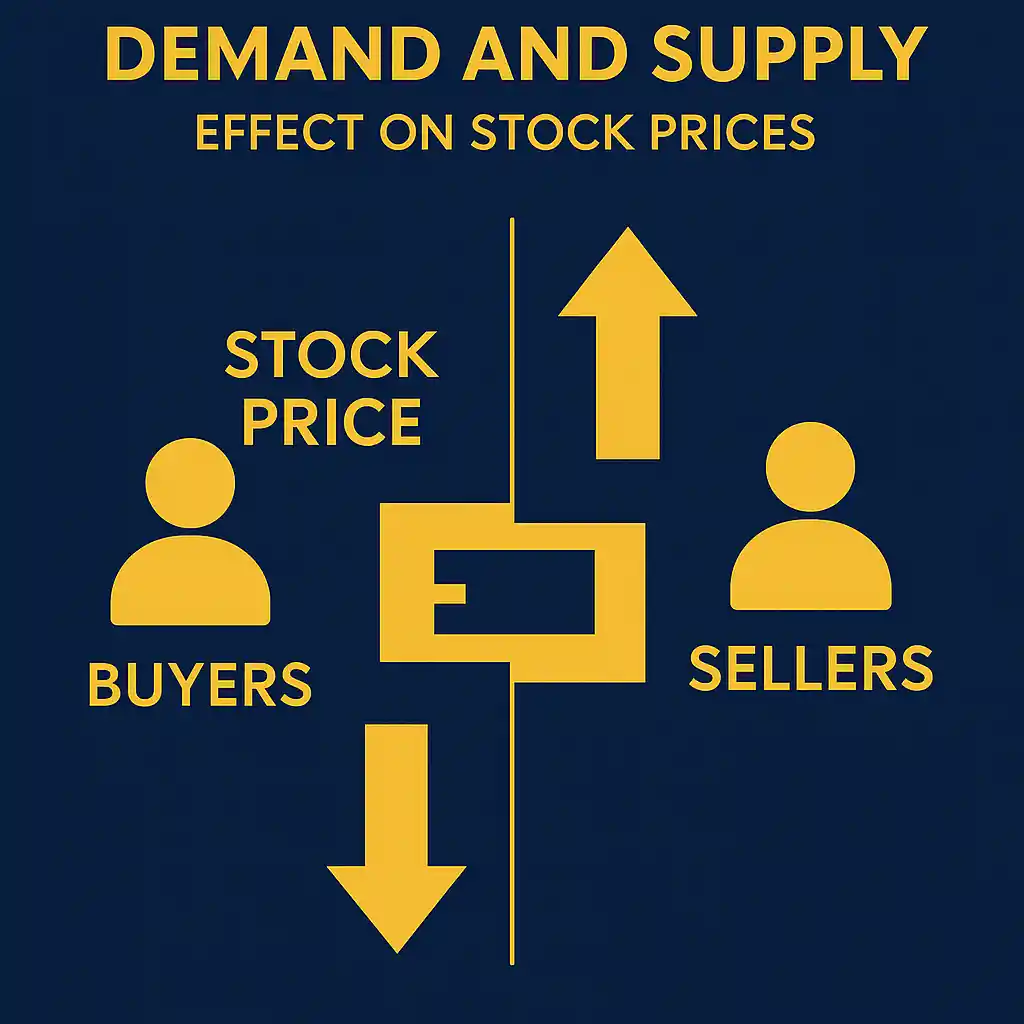
⚙️ The Basic Principle — Demand and Supply
Just like vegetables or gold prices, stock prices depend on demand and supply.
- When more people want to buy a stock → demand goes up → price rises.
- When more people want to sell → supply goes up → price falls.
🧩 Example:
Let’s say:
- 10,000 investors want to buy Infosys shares.
- But only 5,000 shares are available for sale.
Result: Price increases because demand > supply.
Similarly, if everyone wants to sell and few buyers exist, the price drops.
This principle is the foundation of how stock prices are decided in real-time.
💻 Who Decides the Price?
Contrary to what many believe, no single person or authority (like SEBI, the government, or even the company) sets the stock price.
Instead, it’s decided automatically through electronic trading systems on the stock exchanges — NSE (National Stock Exchange) and BSE (Bombay Stock Exchange).
Every second, millions of buy and sell orders are matched by a system called the Order Matching Engine.
🏦 The Role of the Stock Exchange
The stock exchange acts as a platform where buyers and sellers meet.
It doesn’t control prices — it just facilitates the trades.
Here’s what happens:
- Investor A wants to buy TCS at ₹3,800.
- Investor B wants to sell TCS at ₹3,800.
- The system matches both orders → trade executed.
That matched price becomes the market price at that moment.
This process happens millions of times every day, making the market dynamic and self-adjusting.
📊 How Prices Change Every Second
The stock price keeps moving because:
- Thousands of investors are constantly updating their orders.
- Some are willing to pay a little more (to buy quickly).
- Some are ready to sell at slightly lower prices (to exit quickly).
This continuous tug-of-war between buyers and sellers creates minute-by-minute price changes.
That’s why when you watch live stock charts, prices seem to dance nonstop.
🔍 Key Factors That Influence Stock Prices
Let’s go beyond demand and supply — what causes investors to want to buy or sell in the first place?
Here are the main drivers of stock prices:
1. Company Performance
Investors prefer companies that show consistent growth and profit.
If quarterly results show higher earnings, demand rises → stock price increases.
📈 Example:
When HDFC Bank reports strong profits, its stock price usually jumps.
📉 On the other hand, if profits fall or losses are reported, prices dip.
2. Economic Conditions
If the economy is doing well — GDP rising, inflation under control, and jobs growing — investor confidence increases.
But during economic slowdowns or high inflation, people sell stocks → prices fall.
3. Interest Rates
When RBI raises interest rates, borrowing becomes costlier, reducing corporate profits → stock prices drop.
When rates fall, it encourages investment → prices rise.
4. Global Market Trends
Indian markets often follow cues from global indices like Dow Jones (US) or FTSE (UK).
If international markets are bullish, Indian stocks usually gain too.
5. Company News & Announcements
- Launch of new products
- Mergers or acquisitions
- Management changes
- Government approvals
- Legal issues
All these can cause instant reactions in stock prices.
For example:
When Tata Motors launches an innovative EV, the stock jumps.
But if a fraud or penalty news breaks, it crashes instantly.
6. Investor Sentiment
Sometimes prices move not because of numbers, but because of emotion — fear and greed.
- Fear causes panic selling
- Greed causes buying rushes
That’s why expert investors say —
“Markets are driven by emotion in the short term, but by fundamentals in the long term.”
📉 Market Orders vs Limit Orders (How They Affect Price)
When you buy or sell a share, you can do it in two ways:
🟢 Market Order
You agree to buy/sell immediately at the current market price.
This increases short-term demand/supply → pushes price movement.
🟡 Limit Order
You set a specific price (e.g., buy only if price falls to ₹1500).
These orders sit in the system and affect future price trends.
Thousands of such limit orders create a visible order book, showing potential price directions.

🧠 The Concept of Fair Value
Every stock has a fair value — the price based on its actual worth (earnings, growth, etc.).
But market prices often deviate due to investor psychology or speculation.
- If market price > fair value → overvalued stock
- If market price < fair value → undervalued stock
Long-term investors like Warren Buffett use fundamental analysis to find undervalued stocks and invest before prices catch up.
📈 Role of Analysts and Institutions
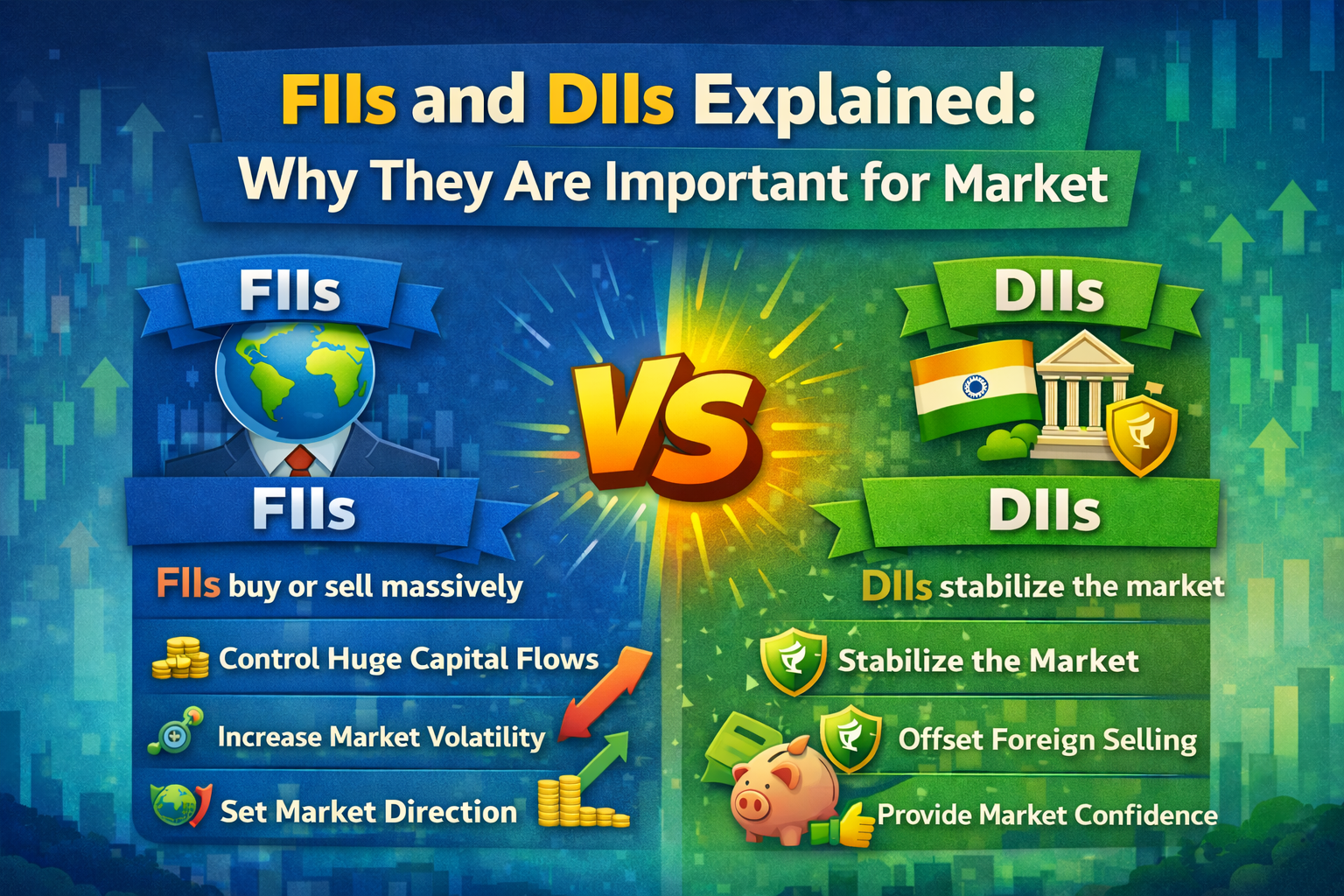
Big institutions (like mutual funds, FIIs, DIIs) buy and sell large quantities of stocks.
Their actions significantly influence stock prices because of high volumes.
When institutions buy → prices rise
When they sell → prices fall
Similarly, analyst recommendations and brokerage reports can trigger buying or selling waves among retail investors.
🔄 How IPO Pricing Works
Before a company’s stock is listed, its Initial Public Offering (IPO) determines its first market price.
In India, IPOs follow the book-building process, where investors bid within a price range (say ₹100–₹120).
After analyzing total bids, the company fixes a final issue price — that becomes its first trading price.
After listing, demand–supply takes over and prices move freely.
🧮 Example: Real-Time Price Movement
Let’s imagine Infosys shares are trading at ₹1,500.
| Time | Action | Impact on Price |
|---|---|---|
| 9:15 AM | Buyers increase demand | Price rises to ₹1,510 |
| 9:30 AM | Big fund sells 1 lakh shares | Price drops to ₹1,495 |
| 10:00 AM | Company announces new deal | Price jumps to ₹1,530 |
This continuous reaction to new information defines the heartbeat of the market.
🧩 Short-Term vs Long-Term Price Movement
| Duration | Price Driver | Typical Behavior |
|---|---|---|
| Short Term | Emotions, news, rumors | Volatile (up & down) |
| Long Term | Earnings, growth, value | Stable upward trend |
Smart investors focus on long-term fundamentals, not daily price swings.
📊 How Algorithms Decide Prices in Modern Markets
Today, most stock price movements are controlled by AI-based trading algorithms and high-frequency traders (HFTs).
These systems:
- Scan millions of data points per second
- Detect buying/selling opportunities
- Execute trades instantly
This automation keeps the market liquid and ensures fair pricing at all times.
💬 Common Myths About Stock Prices
❌ “Companies decide their share price daily.”
➡️ Wrong — it’s determined by buyers and sellers on exchanges.
❌ “SEBI controls prices.”
➡️ SEBI only regulates fairness — it doesn’t fix prices.
❌ “Expensive stocks mean better companies.”
➡️ Not always. Stock price ≠ company quality; valuation matters.
📚 Example to Simplify It All
Imagine the stock market as a huge auction hall.
- Buyers raise hands with bids.
- Sellers quote their prices.
- The moment both agree — that’s the current stock price.
Tomorrow, new buyers may offer more, and prices will change again.
That’s how every second of trading creates new price points.
🏁 Final Thoughts
Stock prices are not set by any single authority — they’re a reflection of collective investor actions.
They change because people’s expectations, company performance, and market sentiment change.
In short:
“Stock prices are decided by the invisible hand of demand and supply — powered by human behavior and market information.”
Understanding this gives you an edge as an investor — because once you know why prices move, you can better decide when to buy or sell.







Leave a Reply