


1. Introduction
Stock market investors often get confused between two of the most widely used investment styles: value investing and growth investing. Both are proven wealth-building methods, but they work in different ways, attract different types of investors, and perform differently in varying economic cycles.
In this detailed guide, you will understand what value investing and growth investing are, how they work, their advantages, risks, long-term performance, and which strategy is better for 2025.
This explanation is written for both beginners and advanced investors who want clarity before choosing an investment style.
2. What Is Value Investing?
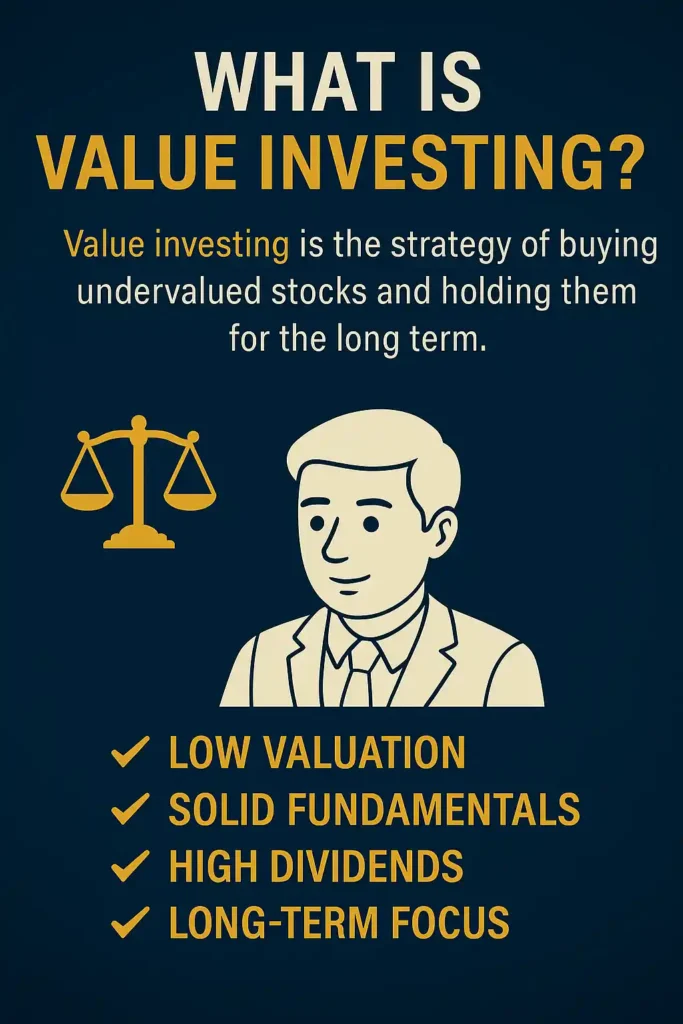
Value investing focuses on buying stocks that are fundamentally strong but available at a lower price than their true worth.
These stocks are known as “undervalued stocks.”
Key Characteristics of Value Stocks
- Low Price-to-Earnings (P/E) ratio
- Low Price-to-Book (P/B) ratio
- High dividend yield
- Stable earnings
- Low market hype
- Clear long-term fundamentals
Value investors believe that the stock market often misprices companies in the short term. Eventually, the stock price moves toward its real value, giving investors significant returns.
Who Made Value Investing Famous?
- Warren Buffett
- Benjamin Graham
- Charlie Munger
Suitable For
Investors who are patient, long-term focused and prefer stable, low-risk companies.
3. What Is Growth Investing?

Growth investing focuses on buying companies that are growing faster than the overall market. These companies usually reinvest their profits to expand rapidly, gain market share, and build future dominance.
Key Characteristics of Growth Stocks
- High revenue growth
- High profit growth potential
- High P/E ratio
- Low or no dividends
- Strong market demand
- High innovation and scalability
Growth stocks often belong to sectors like technology, EVs, biotech, AI, and digital platforms.
Suitable For
Investors who can tolerate volatility and want higher long-term returns with higher short-term risk.
4. Value Investing vs Growth Investing: Key Differences
Below is a clean comparison to understand both strategies:
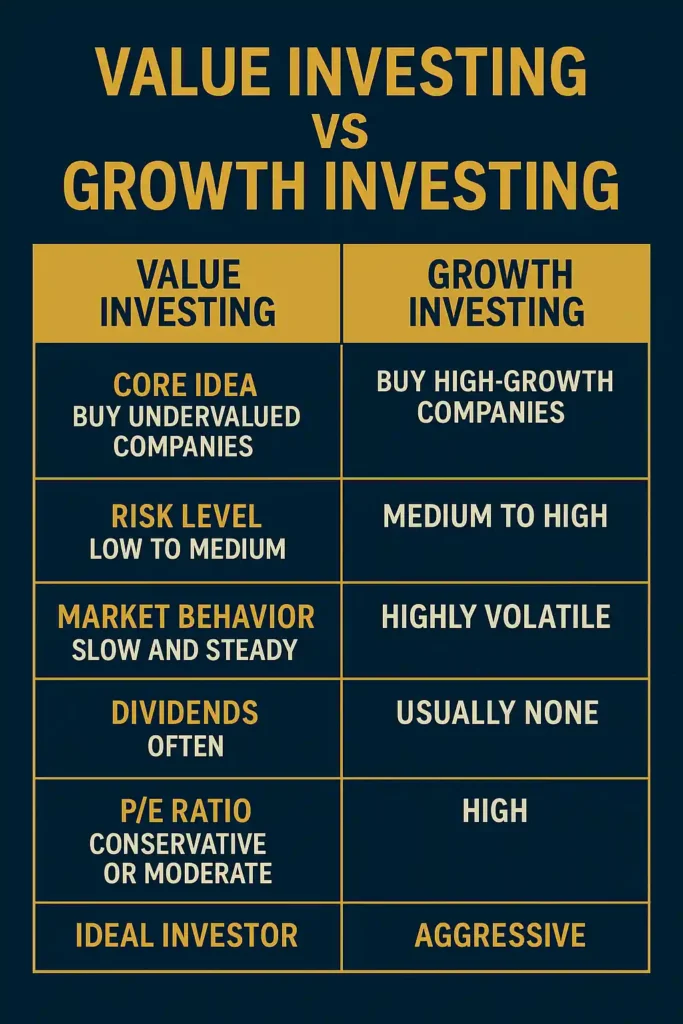
| Factor | Value Investing | Growth Investing |
|---|---|---|
| Core Idea | Buy undervalued companies | Buy high-growth companies |
| Risk Level | Low to Medium | Medium to High |
| Market Behavior | Slow and steady | Highly volatile |
| Dividends | Often high | Usually low or none |
| P/E Ratio | Low | High |
| Ideal Investor | Conservative or moderate | Aggressive |
| Return Pattern | Stable but slow | High but uncertain |
Both strategies have delivered great returns historically, but each performs better under different market conditions.
5. Advantages of Value Investing
1. Lower Risk
Value stocks generally have strong financials, reducing downside risk.
2. Good for Long-Term Stability
These companies grow slowly but consistently.
3. High Dividend Income
Many value companies share profits through dividends.
4. Safer During Market Crashes
Value stocks tend to fall less during bearish markets.
6. Advantages of Growth Investing
1. Potential for Very High Returns
Growth companies can multiply in value over time.
2. Innovative Sectors
Technology, AI, cloud computing, EVs, biotech, etc.
3. EarlyStage Opportunities
Investors may ride major bull runs if the company performs well.
4. Strong Compounding
Rapid earnings growth accelerates returns significantly.
7. Risks in Value Investing
- Undervalued stocks may stay undervalued for years
- Company fundamentals may weaken over time
- Some low-priced stocks may be “value traps”
- Slow capital appreciation
8. Risks in Growth Investing
- Highly volatile stock price movements
- Expensive valuations can crash during corrections
- No dividends, very long payback period
- Company growth may slow unexpectedly
9. Which Strategy Performs Better in 2025?
Based on current trends:
Value Investing Works Well When
- Interest rates are rising
- Inflation is high
- The market is correcting
- Investors seek safety
Growth Investing Works Well When
- Interest rates are stable or falling
- Economic conditions improve
- Technology and digital sectors expand
- Risk appetite increases
In 2025, both strategies can work, but diversification between value and growth stocks is recommended.
10. Example Stocks (Educational Only)
(No recommendations, only examples to explain the concept)
Examples of Value Stocks
- Traditional banks
- Insurance companies
- Infrastructure companies
- FMCG giants
- Stable manufacturing companies
Examples of Growth Stocks
- Cloud computing companies
- AI-based firms
- EV manufacturers
- SaaS companies
- Semiconductor firms
11. Which Strategy Should YOU Choose?
Choose Value Investing If:
- You prefer low-risk investments
- You want steady returns
- You like dividend income
- You are a long-term conservative investor
Choose Growth Investing If:
- You can handle volatility
- You want high long-term returns
- You prefer innovative companies
- You are an aggressive investor
The Best Approach
A mix of both strategies provides stability AND high-growth potential.
12. Final Conclusion
Value Investing and Growth Investing are two powerful strategies with proven long-term potential. The best choice depends on your personal risk appetite, investment horizon, and financial goals.
A balanced diversified portfolio that includes both value and growth stocks is the most effective strategy for 2025.









Leave a Reply